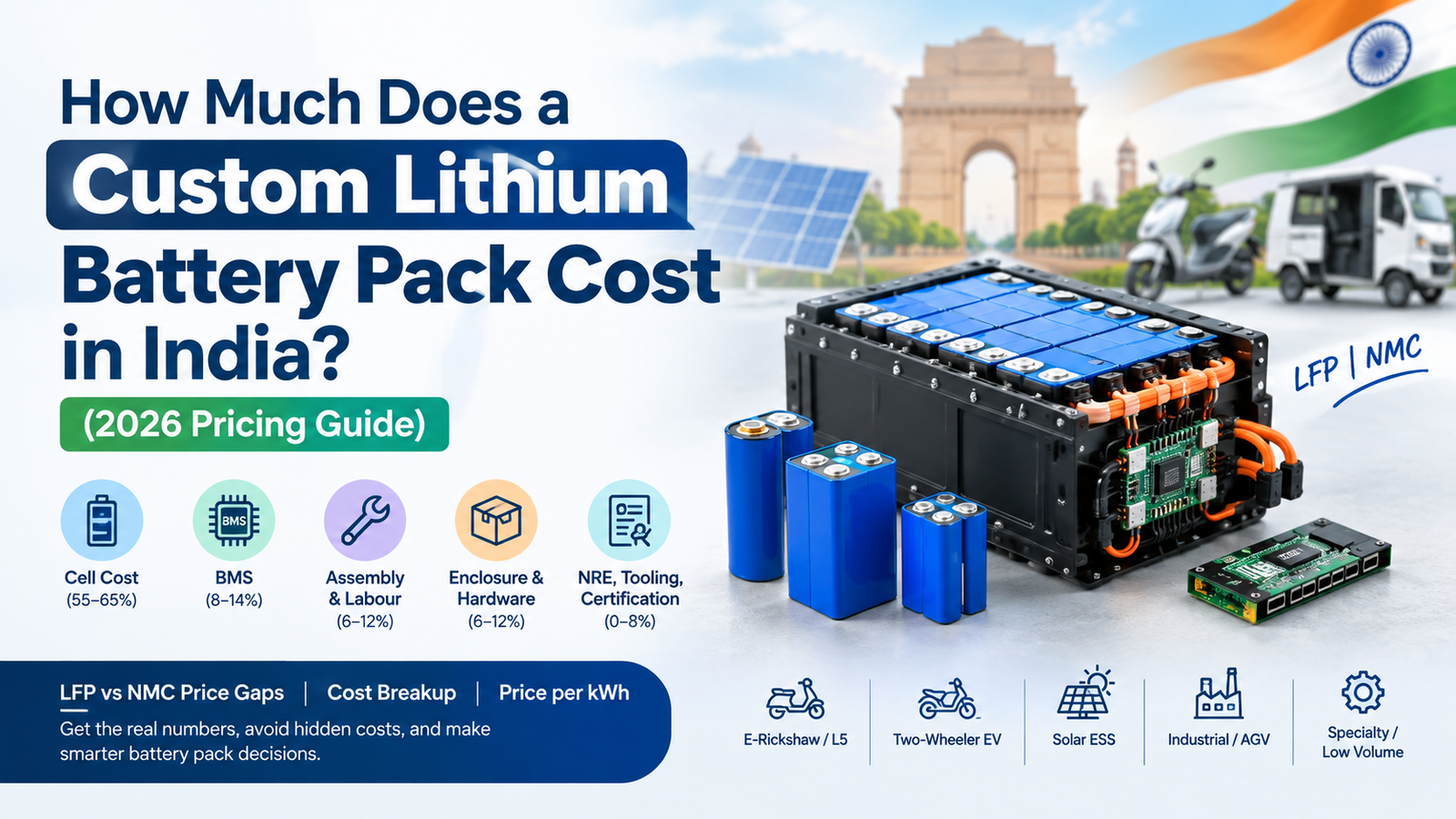
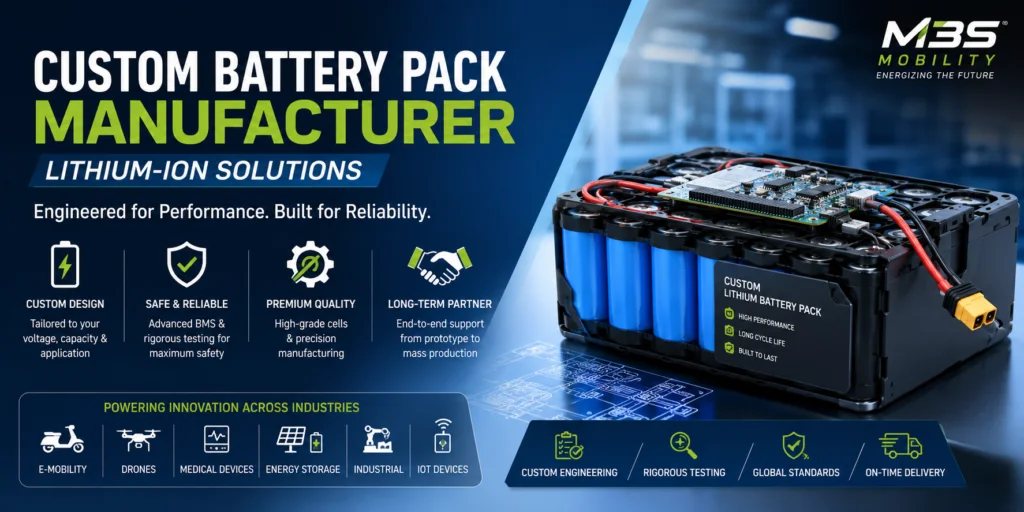
Choosing the right Custom Battery Pack Manufacturer quietly shapes everything downstream in your product. Runtime, safety, field performance, whether the device passes certification the first time — it all traces back to the pack inside. And here’s what most product teams learn the hard way: an off-the-shelf cell rarely fits a real-world application cleanly. That gap is exactly where M3S Mobility works. As a dedicated Custom Battery Pack Manufacturer, we design, engineer, and build lithium-ion energy solutions tuned to the precise voltage, capacity, form factor, and safety profile your product demands.
This guide covers what a serious battery partner actually does, how a custom lithium battery pack is designed from the ground up, why Battery Management Systems matter more than most buyers realise, which chemistries fit which jobs, and how to choose a supplier that ships reliable packs on schedule. Let’s get into it.
Why the Right Battery Partner Beats Off-the-Shelf
Off-the-shelf batteries are built for the average. Your product isn’t average. A drone needs a high discharge rate in a tight weight envelope. A medical device needs certified safety and predictable cycle life. An electric vehicle needs thermal stability across brutal duty cycles. One generic pack cannot serve all three — and forcing it to try is how you end up with overheating, early failures, and returns piling up.
A capable supplier starts from your requirements, not from a catalogue. At M3S Mobility, we ask about your device’s peak and continuous current draw, its operating temperature range, the physical space you have to work with, the runtime your users expect, and the regulatory standards you’re chasing. From those inputs, we engineer a custom lithium battery pack that fits — literally and electrically.
Worth noting: the difference shows up in the numbers. India’s lithium-ion battery market has been growing rapidly, driven by electric mobility, renewable storage, and consumer electronics. The country’s push toward EV adoption and domestic manufacturing under national incentive schemes has made local, tailored battery pack design more valuable than ever. Buyers who once imported generic packs now want a partner who can iterate fast, hold quality, and support them for the long haul.
Honestly, most businesses underestimate how much a well-matched pack saves. Fewer warranty claims. Longer product life. Better user reviews. The pack stops being a liability and starts being a competitive edge. A generic cell that’s “close enough” bleeds money slowly — through returns, through reputation, through the engineering hours you burn troubleshooting a problem you could have designed out at the start.
Think about it from your customer’s side. They don’t see the cell. They see whether the device lasts a full shift, whether it charges predictably, whether it ever gets warm in a way that worries them. Every one of those impressions is set by decisions made during battery pack design. Get those decisions right and the product feels solid. Get them wrong and no amount of marketing fixes it.
What Makes M3S Mobility a Trusted Custom Battery Pack Manufacturer
We’re not a reseller sticking a label on someone else’s cells. M3S Mobility is a hands-on custom battery pack manufacturer that controls the process end to end — from cell selection and battery pack design through assembly, Battery Management Systems integration, testing, and delivery. That vertical control is the whole point. When one team owns the pack from brief to shipment, accountability never gets lost in a handoff.
Precision Engineering
Every custom lithium battery starts on the engineering bench. We model the pack for performance and safety before a single cell is welded. That means calculating thermal behaviour, mapping current paths, and validating the mechanical layout so the pack survives vibration, shock, and daily handling. Precision here isn’t perfectionism for its own sake — it’s what keeps a pack safe and consistent across thousands of units.
Application-Specific Design
We build for what your product actually does. E-bikes, EVs, drones, energy storage systems, medical equipment, IoT devices, industrial tools — each gets a battery pack design shaped around its real duty cycle, not a generic template. A pack for a delivery drone that cycles hard every day looks nothing like a pack for a backup power unit that sits idle then discharges slowly. Treating them the same is a mistake we don’t make.
Quality You Can Audit
Reliability isn’t a slogan here. It’s a process. Each custom lithium battery pack passes through staged quality control — incoming cell inspection, in-process checks, and final validation — so what leaves our facility performs the way the spec promised. If a unit doesn’t meet the mark, it doesn’t ship. That’s the standard, and it’s why clients trust us with products where failure isn’t an option.
Long-Term Partnership
The best supplier relationships last years, not one purchase order. We support revisions, scale production as your volumes grow, and stay reachable when you need answers. That continuity is a big part of why clients keep coming back — the pack you launch with is rarely the last pack you’ll need, and having the same engineering team through every iteration saves enormous time.
The Custom Lithium Battery Pack Design Process, Step by Step
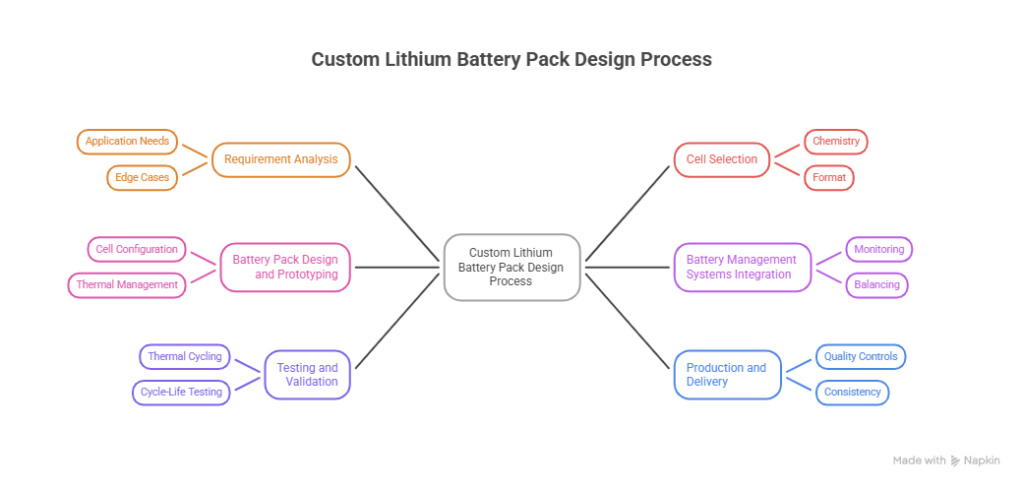
People often picture battery manufacturing as bolting cells together. The reality is more deliberate. Here’s how a proper custom lithium battery pack comes to life at M3S Mobility, stage by stage.
1. Requirement Analysis
We begin with a conversation, not a quote. What’s the application? What voltage and capacity does it need? What’s the discharge profile — a steady draw, or sharp peaks? How much space is available, and what shape? Which certifications matter? This phase is where a good battery partner earns its keep, because getting the brief right prevents expensive rework later. A misread requirement at this stage multiplies into problems everywhere downstream, so we slow down and get it precise.
We also probe the edge cases that buyers forget to mention. What’s the coldest environment the device will see? The hottest? Will it charge from a wall adapter, a solar input, a vehicle system? Will it sit in storage for months, or cycle daily? These details shape chemistry and BMS choices in ways that aren’t obvious until you’ve built a few hundred packs and seen where the surprises hide.
2. Cell Selection
Not all cells are equal. Cylindrical, prismatic, and pouch cells each bring trade-offs in energy density, cost, safety, and form. LFP — lithium iron phosphate — chemistry offers excellent safety and cycle life. NMC offers higher energy density for weight-sensitive builds. We match chemistry and cell format to your priorities, sourcing quality cells rather than the cheapest available. Cell quality is the foundation; no amount of clever engineering rescues a pack built on inconsistent cells.
Cell format matters as much as chemistry. Cylindrical cells are robust and well-understood, easy to configure in large arrays. Prismatic cells pack energy densely into rectangular spaces. Pouch cells flex into thin or irregular form factors. The right choice depends on your space, your weight budget, and how the pack will be handled in the field.
3. Battery Pack Design and Prototyping
Now the design takes shape. Our engineers lay out the cell configuration — the series and parallel arrangement that hits your target voltage and capacity — design the mechanical housing, plan thermal management, and specify the Battery Management Systems. We build a prototype and put it through its paces before committing to production. This is where battery pack design turns from a spec sheet into a physical object you can test.
Thermal management deserves special attention. Cells generate heat under load, and heat is the enemy of both performance and longevity. Depending on the application, we design in spacing, heat-spreading materials, or active cooling paths so the pack stays within its safe temperature window even when it’s working hard. Skip this and you get a pack that ages fast and, in the worst case, becomes dangerous.
4. Battery Management Systems Integration
This is the brain of the pack. The system monitors voltage, current, and temperature across every cell group, balances charge, and shuts things down safely if anything drifts out of range. More on why Battery Management Systems matter below — but no serious pack ships without one, and the quality of that integration separates a safe product from a recall waiting to happen.
5. Testing and Validation
Prototypes face thermal cycling, cycle-life testing, load testing, and safety checks. We measure real performance against the spec and refine until it holds. This is the step cheap suppliers skip and later regret. Testing is where assumptions meet reality — a design that looks perfect on paper sometimes behaves differently under a real load, and it’s far better to discover that on a test bench than in a customer’s hands.
Cycle-life testing in particular takes patience. A pack rated for hundreds or thousands of cycles has to actually deliver them, and the only honest way to know is to run the cycles and measure the fade. We’d rather find a weakness in validation than ship it and find out through warranty claims.
6. Production and Delivery
Once validated, the custom lithium battery pack moves to full production under the same quality controls. We assemble, test each unit, and ship on schedule — because a great pack that arrives late still hurts your launch. Consistency at scale is its own discipline: the hundredth pack has to match the first, and that only happens with disciplined process control at every station.
Battery Management Systems: The Component That Earns Its Keep
Let’s be honest — buyers love talking about capacity and voltage, then gloss over the electronics that protect the pack. That’s backwards. Battery Management Systems are what separate a safe, long-lived pack from a genuine fire risk.
A BMS does several jobs at once. It monitors each cell’s voltage so none gets overcharged or drained too deep. It watches temperature and current, cutting power before conditions turn dangerous. It balances cells so the whole pack ages evenly instead of one weak cell dragging the rest down. And in smarter packs, it reports state-of-charge and health data your product can display or log.
Why does this matter so much? Because lithium-ion cells are energy-dense and unforgiving when abused. Overcharge one, short another, let a pack cook in the sun without protection — and you risk thermal runaway, the chain reaction behind battery fires. A well-designed BMS is the guardrail that keeps that from happening. It’s cheap insurance against catastrophic, brand-destroying failure.
Cell balancing is a quieter but equally important job. In any multi-cell pack, individual cells drift slightly in capacity over time. Without balancing, the weakest cell hits its limits first, forcing the whole pack to stop short of its potential and aging unevenly. Good Battery Management Systems equalise the cells so the pack delivers its full rated capacity for far longer. That’s the difference between a pack that lasts two years and one that lasts five.
When you evaluate a supplier, ask hard questions about their BMS approach. Do they design it around your pack’s chemistry and load, or drop in a generic board and hope? The answer tells you whether they treat safety as engineering or as an afterthought. At M3S Mobility, the BMS is designed into every custom lithium battery from the start, sized to the pack’s chemistry and duty cycle rather than bolted on generically.
Industries We Serve as a Lithium-ion Battery Pack Manufacturer
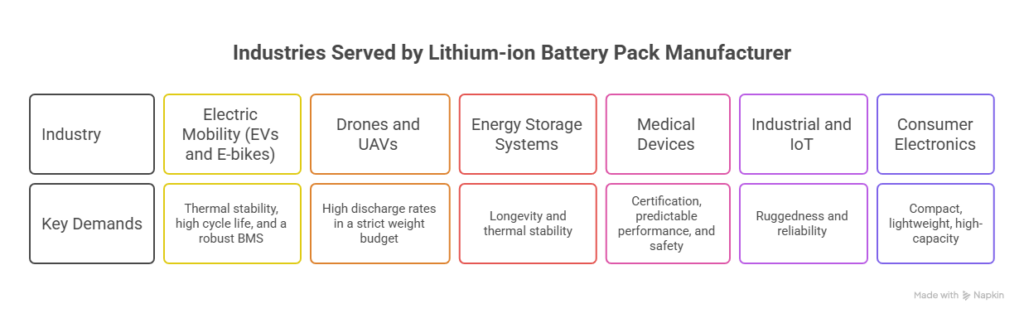
A capable Lithium-ion Battery Pack Manufacturer isn’t locked into one sector. The underlying discipline — safe, reliable, application-matched battery pack design — carries across many industries. Here’s where our work shows up, and what each field demands.
Electric Mobility (EVs and E-bikes): Traction packs need thermal stability, high cycle life, and a robust BMS. This is a fast-growing demand area as India’s EV market expands under government incentives. Riders and drivers expect range and reliability, and a poorly built traction pack undermines both. Here the pack is the single most expensive and most safety-critical component, so the engineering has to be flawless.
Drones and UAVs: High discharge rates in a strict weight budget. Every gram and every amp counts, so the pack has to be engineered tight. Drone packs also endure rapid charge-discharge cycles and demanding flight loads, which pushes both cell selection and thermal design. A pack that’s a few grams too heavy or a few amps short of peak can ground the aircraft.
Energy Storage Systems: Solar and backup storage lean on LFP chemistry for safety and long life. Packs here run thousands of cycles, so the design prioritises longevity and thermal stability over raw energy density. These systems often sit in homes and businesses, so safety margins matter enormously — an ESS pack has to be boringly, dependably reliable for a decade.
Medical Devices: Certification, predictable performance, and safety dominate. A medical-grade pack leaves no room for shortcuts — regulatory compliance and traceability are as important as raw performance. When a device supports patient care, the battery cannot be the weak link, and documentation has to prove it.
Industrial and IoT: Sensors, trackers, handheld tools, and automation gear all need packs shaped to odd form factors and long standby life. Industrial environments are harsh, so ruggedness and reliability come first. A tracker that dies in the field or a tool that fails mid-shift costs far more than the pack itself.
Consumer Electronics: Compact, lightweight, high-capacity — where energy density and clean industrial design meet. These packs often use pouch cells to fit slim, curved, or unusual enclosures. The battery has to disappear into the product while quietly delivering the runtime users expect.
Across all of these, the constant is customisation. A generic pack might limp along; a purpose-built one performs. The industries differ wildly, but the engineering principles — right chemistry, sound configuration, proper thermal design, solid BMS, real testing — stay the same.
Custom Lithium Battery vs Off-the-Shelf: A Clear Comparison
Buyers often ask whether the custom route is worth it. Here’s an honest side-by-side.
| Factor | Off-the-Shelf Battery | Custom Battery Pack |
| Fit to application | Approximate, a compromise | Exact voltage, capacity, form |
| Safety (BMS) | Generic or minimal | Designed for the specific pack |
| Form factor | Fixed shapes | Built to your available space |
| Cycle life in use | Often shorter under mismatch | Optimised for your duty cycle |
| Certification support | Limited | Guided by the manufacturer |
| Scalability | Whatever’s in stock | Grows with your volumes |
| Long-term support | Usually none | Ongoing engineering partnership |
The pattern is clear. If your product is standard and low-stakes, a stock cell might do the job. If performance, safety, or brand reputation are on the line, a custom lithium battery pack pays for itself many times over. The upfront engineering investment looks larger, but the total cost of ownership — fewer failures, longer life, less support burden — almost always favours the purpose-built pack.
How to Choose the Right Battery Pack Supplier
Not every supplier who claims the title can back it up. Here’s what actually separates a dependable partner from a risky one.
Engineering Depth
Can they design a pack, or only assemble one? Real battery pack design means thermal modelling, cell configuration expertise, and BMS integration — not just spot-welding to a diagram you provide. Ask to talk to their engineers. A supplier with genuine depth will happily walk you through their design reasoning; one without it will deflect.
BMS Capability
Ask how they approach Battery Management Systems. A manufacturer who designs the BMS around your pack’s chemistry and load is playing a different game from one who drops in a generic board and moves on. Because the BMS governs both safety and longevity, this single question filters out a lot of weak suppliers fast.
Quality Systems
Look for staged quality control and real testing — thermal, cycle-life, load, and safety. Ask what happens to a pack that fails validation. The answer reveals their standards. A serious operation has a clear process for catching and rejecting defects; a casual one ships and hopes.
Chemistry Range
LFP, NMC, and other chemistries suit different needs. A supplier who works across chemistries can recommend what’s right for your application instead of steering you toward whatever they happen to stock. Beware anyone who insists a single chemistry is the answer to every problem — that’s a sales position, not an engineering one.
Scalability and Support
Your prototype run and your production run are different animals. A strong partner scales with you and stays available for revisions, troubleshooting, and future generations of your product. Ask about their capacity and their track record moving clients from pilot to volume — the transition trips up suppliers who look fine at prototype scale.
Local Presence and Lead Time
A domestic supplier shortens lead times, simplifies communication, and makes iteration faster. For Indian product teams, working with a local custom battery pack manufacturer removes a lot of friction — no time-zone lag, no import delays, no lost-in-translation specs. When you need to iterate a design quickly, proximity is a real advantage.
Battery Chemistry Options at a Glance
Chemistry choice drives everything about how your custom lithium battery behaves — its safety, weight, lifespan, charge speed, and cost. Here’s a quick reference to the main options.
| Chemistry | Strengths | Best For |
| LFP (LiFePO4) | Safety, long cycle life, thermal stability | Energy storage, EVs, solar |
| NMC | High energy density, lighter weight | Drones, portable devices, EVs |
| LTO | Extreme cycle life, very fast charge | Specialised industrial use |
| Li-Polymer | Flexible form factor, thin builds | Wearables, compact electronics |
A good partner walks you through these trade-offs instead of defaulting to one. LFP wins on safety and longevity but weighs more for the same energy. NMC packs more punch per kilogram, which matters when weight is critical, but demands careful thermal and BMS design. LTO is a niche champion for applications that cycle relentlessly and need rapid charging. Li-Polymer’s flexibility makes it the go-to for slim consumer gadgets. The right custom lithium battery always starts with the right chemistry for your specific job.
What Sets Leading Custom Battery Pack Manufacturers Apart
The market is crowded, and plenty of custom battery pack manufacturers look similar on a website. Dig deeper and the differences are stark. A leading Custom Battery Pack Manufacturer owns its engineering, controls its quality process, and stands behind its packs long after delivery. A weaker one outsources the hard parts, skips real testing, and disappears when problems surface.
Consider the design conversation itself. A strong Custom Battery Pack Manufacturer asks probing questions before quoting — about duty cycle, environment, certification, and scale — because those answers shape the entire build. A weak supplier just asks for voltage and capacity and calls it a day. That early rigour is the clearest signal of who you’re dealing with.
Then there’s testing discipline. The best custom battery pack manufacturers treat validation as sacred, running thermal, load, and cycle-life tests before anything ships. They’d rather delay a launch than send out a pack that hasn’t earned its rating. This is where corners get cut in a hurry by suppliers chasing volume over quality, and it’s precisely where failures are born.
Support after the sale rounds out the picture. Products evolve, and a custom lithium battery pack that was perfect last year may need revisions as your device changes. A Custom Battery Pack Manufacturer worth partnering with treats each project as an ongoing relationship, scaling production and refining battery pack design as your requirements shift. At M3S Mobility, that long-term commitment sits at the centre of how we work — we’d rather build a decade-long partnership than a single transaction.
The takeaway is simple. When you compare custom battery pack manufacturers, look past the brochure. Ask about engineering depth, Battery Management Systems design, testing rigour, chemistry range, and long-term support. Those five factors reveal the real capability behind the label, and they’re how a discerning buyer separates a genuine Custom Battery Pack Manufacturer from a reseller in disguise.
Sustainability and the Bigger Picture
There’s a dimension to battery work that goes beyond any single order: sustainability. Lithium-ion packs power the shift to cleaner energy — electric vehicles, solar storage, and efficient devices all depend on them. Building packs that last longer and perform reliably is itself an environmental good, because it means fewer replacements and less waste.
At M3S Mobility, we pair pack manufacturing with electronics refurbishment, extending the useful life of devices rather than sending them to landfill early. A well-designed pack that lasts five years instead of two isn’t just better for your customers — it’s better for the planet. Responsible cell sourcing and end-of-life recycling round out an approach that treats sustainability as engineering, not marketing. As battery volumes grow across every industry, that responsibility only becomes more important.
The M3S Mobility Advantage
So why work with us specifically? A few reasons stand out.
We’re a genuine custom battery pack manufacturer, not a middleman. That means faster answers, tighter quality control, and accountability that stays in one place rather than getting lost between vendors. Our battery pack design process is thorough — requirement analysis, cell selection, prototyping, BMS integration, validation, and production, each done properly and in order. And our Battery Management Systems are engineered for the pack, not borrowed from a shelf.
We also think long-term. A custom lithium battery pack is rarely a one-off; products evolve, volumes grow, new variants appear. We’re built to support that journey, scaling production and iterating designs as your needs change. The same engineering team that builds your prototype is there when you’re ready for your tenth production run.
Add to that a real focus on sustainability — extending device life through reliable packs and supporting electronics refurbishment — and you get a partner who cares about outcomes, not just orders. That combination of engineering rigour, safety focus, and genuine partnership is what sets our work apart.
Common Mistakes to Avoid When Sourcing Battery Packs
A few missteps come up again and again, and they’re worth naming so you can sidestep them.
The first is chasing the lowest price without weighing total cost. A cheap pack that fails early, triggers warranty claims, or damages your reputation costs far more than a well-built one. Price matters, but it’s the wrong headline metric. Judge value across the pack’s whole life, not its purchase order.
The second is underspecifying the brief. Handing a supplier only a voltage and capacity, then expecting a perfect result, sets everyone up to fail. The more you share about environment, duty cycle, and certification needs, the better your battery pack design will fit. A good manufacturer draws these details out, but you speed things up by volunteering them.
The third is ignoring the BMS. Buyers who fixate on capacity and skip Battery Management Systems questions often discover safety and longevity problems too late. Treat the BMS as central, not optional.
The fourth is picking a supplier who can’t scale. A prototype specialist who stumbles at volume leaves you stranded right when demand takes off. Confirm your partner can grow with you before you commit. The right custom lithium battery partner supports you from first prototype through mass production without a hitch.
Avoid these four and you dramatically improve your odds of a smooth, successful build with a dependable custom battery pack manufacturer at your side.
Ready to Build Your Custom Battery Pack?
Choosing the right Custom Battery Pack Manufacturer shapes your product’s performance, safety, and reputation for years to come. M3S Mobility brings engineering-led battery pack design, robust Battery Management Systems, rigorous testing, and a genuine long-term partnership to every custom lithium battery pack we build. Whether you need a custom lithium battery for a drone, an EV, an energy storage system, a medical device, or an industrial tool, we design it to fit — precisely, safely, and reliably. Reach out to M3S Mobility today and let’s engineer the pack your product deserves.
Frequently Asked Questions
What does a custom battery pack manufacturer actually deliver?
A capable custom battery pack manufacturer translates your voltage, capacity, form factor, and duty cycle into a production-ready lithium-ion pack—with BMS, mechanical packaging, validation testing, and documentation that OEMs can take through certification.
How long does a custom lithium battery pack project take?
Typical timelines run 6–14 weeks from locked specification to pilot samples, depending on cell lead times, tooling, and certification scope. Production scale-up follows once samples clear electrical and environmental tests.
Which chemistry should Indian OEMs choose first?
LFP is usually preferred for high-cycle commercial fleets and stationary use. NMC or NCA suits higher energy-density mobility where range or weight dominates. Your custom battery pack manufacturer should model both against temperature, C-rate, and warranty targets—not brochure Wh/kg alone.
What should I share to get an accurate quote?
Share target voltage and Ah, peak/continuous current, enclosure limits, operating temperature, cycle-life expectation, certification list (AIS/BIS/UN38.3 as applicable), and annual volume. Clear inputs cut redesign loops and protect launch schedules.