Blog

Your blog category

Industrial Battery Manufacturer India
Blog

Industrial Battery Manufacturer in India: Applications & Buying Guide

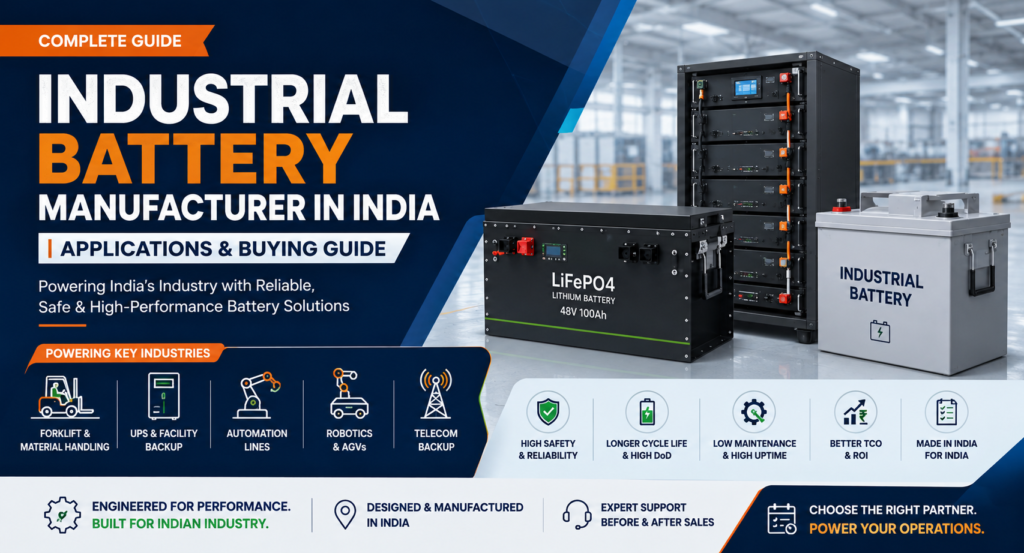
If your plant runs forklifts, UPS rooms, automation cells, or telecom backup, picking an industrial battery manufacturer is an uptime decision—not a catalogue browse. Lead-acid still sits in many Indian factories, but industrial lithium battery packs are taking the shifts that can’t afford midday swaps. This guide covers where an industrial battery pack india programme fits, how to specify an industrial energy storage battery, and what to ask before you award a PO. You’ll get application tables, a buying checklist, and the mistakes that turn “cheap” into downtime in Delhi NCR and beyond. What Does an Industrial Battery Manufacturer Do? An industrial battery manufacturer designs or builds packs for non-passenger duty: material handling, factory automation, backup power, and site storage. The brief prioritizes cycle life, peak current, serviceability, and safety documentation over showroom styling. Compared with consumer inverter brands, a serious industrial battery manufacturer talks about CAN/RS485, rack or tray mechanics, and mean time to repair. That’s the difference between a warehouse that runs three shifts and one that waits on a swollen pack. India’s PLI and Make-in-India push improved cell access, but industrial buyers still need pack-level engineering for heat, dust, and vibration. That’s why a true industrial battery manufacturer brief looks different from a retail inverter RFQ. Industrial Lithium Battery vs. Legacy Lead-Acid An industrial lithium battery usually means LFP or NMC packs with a BMS, higher usable DoD, and faster charge than flooded or VRLA banks. For many forklift and UPS upgrades, LFP is the default chemistry. Factor Lead-acid Industrial lithium battery Usable DoD ~50% typical ~90–95% with proper BMS Opportunity charge Limited Strong (fast partial charges) Maintenance Watering/equalizing Mostly BMS monitoring Weight / footprint Heavier Lighter for same usable kWh Upfront cost Lower Higher; TCO often wins TCO wins when labor for battery changes and downtime matter. A credible supplier will model that—not only quote ₹/Ah. Example: a three-shift forklift fleet that currently swaps lead-acid mid-shift may reclaim labor and truck availability after moving to opportunity-charged lithium. A single-shift UPS room with rare outages may see a slower payback—still fine if weight, footprint, or maintenance risk is the driver. Run the numbers for your utilization before you generalize from someone else’s case study. For AGV and robotics fleets, count dock availability and mean charge minutes between missions. A pack that charges fast but overheats in a sealed chassis isn’t a win. Thermal margins belong in the TCO model beside rupees. Core Applications for Industrial Battery Pack India Programmes Forklift and material handling Forklift packs need high discharge, regenerative acceptance on some platforms, and tray compatibility. Opportunity charging between shifts is why fleets move to an industrial lithium battery. Ask your industrial battery manufacturer about connector standards and weight ballasting if the truck needs mass for stability. UPS and facility backup UPS rooms want predictable runtime and clear BMS alarms. An industrial energy storage battery here may be rack-mounted with hot-swap modules. Dust and 40°C+ rooms around Indian factories are normal—design for them. Automation lines Conveyors, AGVs, and PLC-backed mobile fixtures need stable voltage under pulsed loads. Automation buyers should treat BMS communication as part of the machine spec when selecting an industrial battery pack in India. Robotics Mobile robotics and AMRs care about energy density, CAN protocols, and charge docks. Cycle life claims must match your daily kilometers, not laboratory 0.2°C curves. Robotics programs often need a flexible industrial battery manufacturer, not a single fixed SKU. Telecom backup Telecom backup sites want long float/calendar life, remote monitoring, and theft-aware enclosures. An industrial energy storage battery for towers differs from a forklift tray even if both say “48V.” Application Typical voltage Priority metrics Forklift 24V / 48V / 80V class Peak current, opportunity charge UPS 48V–high voltage strings Runtime, alarms, module swap Automation 24V / 48V Pulse load, protocol Robotics 24V–96V Wh/kg, dock charging Telecom backup 48V Calendar life, remote SOC How to Specify an Industrial Energy Storage Battery Write the duty cycle first. An industrial energy storage battery RFQ without peaks, ambient, and autonomy hours invites optimistic quotes. Include: Then shortlist each industrial battery manufacturer against that sheet. For multi-site rollouts, insist on identical firmware configs so maintenance SOPs stay sane. Buying Process: From RFQ to Pilot That’s how industrial buyers avoid buying a demo queen that fails on night shift. Stage Owner Exit criteria Spec freeze Ops + engineering Signed load profile Supplier shortlist Procurement 2–3 audited plants Pilot Ops 30–90 days duty data Scale Procurement + OEM Locked BOM & SLA Integration Details Factories Forget Mechanical fit is only half the job. An industrial lithium battery drop-in still needs charger handshake, interlock wiring, and sometimes ballast weight for forklift stability. Budget engineering hours for those interfaces. For automation cells, map emergency-stop behavior: does the pack contactor open cleanly, and how does the PLC see the fault? For robotics docks, confirm alignment tolerances and charge-contact wear. For telecom backup, define generator start logic and low-voltage disconnect so site techs aren’t guessing at 2 a.m. Write these into the purchase file. A strong industrial battery pack india partner will respond with drawings and a commissioning checklist—not “our pack is universal.” Safety, Fire Response, and Site Rules Factories and warehouses increasingly ask about thermal event response. Your industrial energy storage battery room may need detection, spacing, and extinguisher type guidance. Don’t assume lead-acid fire rules transfer one-for-one. Train forklift operators on charge etiquette: no blocked vents, no improvised cables, and no bypassing BMS faults. Automation and robotics teams should log fault codes the way they log PLC alarms. UPS and telecom backup rooms need clear SOC visibility for facility managers. An industrial battery manufacturer that offers commissioning support and operator one-pagers reduces early misuse claims. Ask for that package in the quote. Costing Beyond the Pack Price Compare proposals on: That framing keeps finance aligned with ops when an industrial lithium battery looks expensive on day one. Many Indian plants recover the gap through opportunity charging and reduced change-out labor within a predictable window—if utilization is

Best Lithium Ion Battery in India
Blog

Best Lithium-Ion Battery in India: How to Choose the Right One

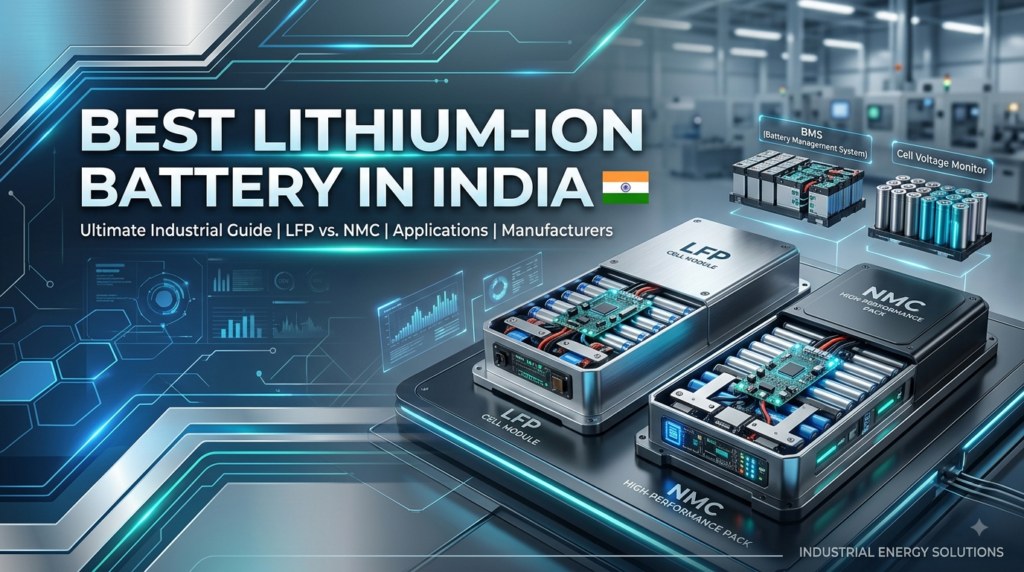
Search “best lithium ion battery in india” and you’ll get brand lists that ignore your duty cycle. Fleet buyers, solar EPCs, and OEM engineers don’t need a trophy shelf — they need a pack that survives heat, vibration, and warranty year two. This buyer’s guide shows how to choose a lithium battery by chemistry, certification, and warranty — then where the best lithium ion battery manufacturers and the best lithium battery brand india shoppers actually fit. You’ll leave with a decision frame for the best lithium ion battery in india for your application, not someone else’s affiliate table. What “Best Lithium Ion Battery in India” Really Means The best lithium ion battery in india is the one that meets energy, power, safety, and cost targets for a defined use case. There isn’t a single winner across e-rickshaws, home inverters, forklifts, and medical carts. Application-based selection beats brand lore. A premium scooter pack can be the wrong buy for a telecom shelter. When people ask for the best lithium ion battery in india, translate that into: chemistry, cycle life, certifications, and service network. Here’s the thing: marketing Ah ratings lie when depth of discharge and BMS cut-offs aren’t published. Read the fine print before you crown any best lithium battery brand india contender. LFP vs NMC: Chemistry First LFP vs NMC is the first fork in how to choose a lithium battery. Factor LFP (LiFePO4) NMC Energy density Lower Higher Cycle life Often 3,000–6,000+ @ recommended DoD Often 1,500–3,000 Thermal behaviour Generally calmer Needs tighter thermal design Cost per kWh Usually lower in India packs Higher, weight-sensitive wins Typical fits Solar, UPS, e-rickshaw, industrial Performance EVs, weight-limited devices If your priority is calendar life and summer abuse in Delhi NCR, LFP often lands as the best lithium ion battery in india for that job. If every kilogram costs range or payload, NMC may win despite a hotter thermal file. Energy density vs cycle life is a trade, not a slogan. Serious suppliers explain that trade in your units (Wh/kg and cycles to 80%), not brochure adjectives. Certifications and Safety: Non-Negotiables Safety certification separates serious supply from marketplace lottery tickets. For many stationary products, BIS / IS pathways matter. For EV traction, AIS-156 and related automotive tests matter. UN38.3 shows up for transport. When you evaluate the best lithium ion battery in india options, ask which certificate applies to your SKU — not which logo appears on a sister product. The best lithium ion battery manufacturers keep sample retention and test reports ready. Honestly, a missing test report is a louder signal than a glossy catalogue. FAME-II and PLI raised volumes; they didn’t erase junk packs in tier-2 distribution. Request the report number, lab name, and the exact model covered. “We are certified” without a matching model string is theatre. For imported cells inside a local pack, clarify which party holds which certificate — cell COA versus pack-level tests are not the same document. If you’re selling into regulated EV categories, budget calendar time for lab queues. ARAI and peer labs book out; that lag belongs in your launch plan when you’re deciding how to choose a lithium battery partner who can actually sample on schedule. Warranty Terms That Actually Protect You Warranty terms decide whether “best” survives month eighteen. Look for: A best lithium battery brand india claim without service depots in your region is a shipping problem waiting to happen. For fleets around Noida and Delhi NCR, local swap logistics matter as much as cell brand. Compare warranty in writing across shortlisted best lithium ion battery manufacturers. Verbal “we support you” isn’t a contract. Also check who pays freight on warranty returns and whether capacity tests use your charger or theirs. Small print here decides whether a claim is practical. If two offers look equal on chemistry, pick the clearer warranty — that’s often the real best lithium battery brand india decision for operators who can’t idle assets for weeks. How to Choose a Lithium Battery: Step-by-Step Process Use this process whenever you’re hunting the best lithium ion battery in india for a programme: That’s how to choose a lithium battery without outsourcing the decision to a sponsored listicle. Buyer type What “best” usually optimises Watch-outs E-rickshaw fleet Cycle life, service speed Fake Ah, weak BMS Solar home / SME DoD, inverter protocol Mixed cell grades Industrial AGV Peak current, CAN BMS Connector and downtime 2W OEM Energy density, AIS-156 Thermal in sealed decks Price, TCO, and What “Cheap” Hides Upfront ₹/kWh is a starting point, not a verdict on the best lithium ion battery in india. Add charger cost, installation, expected replacement year, and downtime. A cheaper pack that dies at month fourteen is not a bargain for a fleet in Noida or a solar site in Rajasthan. Ask for cycle life at your DoD and temperature, not only at 25°C lab conditions. India ambient is the real test. Credible makers publish or at least discuss derating curves; traders usually don’t. GST invoices, warranty registration, and spare BMS boards belong in the commercial checklist. If a deal is cash-only with no serial traceability, walk away — whatever the best lithium battery brand india sticker says on the shrink wrap. Real-World Scenarios: Matching Pack to Job E-rickshaw operator, Delhi NCR: Prioritise LFP, serviceable modules, and a supplier who stocks swaps locally. Here, how to choose a lithium battery starts with daily kilometres and charger access at the stand, not brochure Wh/kg. Home / SME inverter buyer: Focus on DoD, inverter protocol, and a reachable service centre. A credible best lithium battery brand india pick for backup may differ from an EV traction specialist. 2W OEM pilot: Weight and AIS-156 path dominate. Shortlist pack partners who already speak automotive test language. C&I solar: Cycle life and fire-safety documentation matter more than peak power. Application-based selection beats copying a neighbour’s SKU. Work through these scenarios and the phrase best lithium ion battery in india stops meaning “whoever ranks first on page

list of lithium ion battery manufacturers
Blog

List of Lithium-Ion Battery Manufacturers

Looking for a list of lithium-ion battery manufacturers in india that isn’t another recycled “Top 10”? Procurement teams, EV OEMs, and solar EPCs need a directory—cell makers, pack assemblers, and vehicle brands with in-house packs—not a popularity contest. This battery manufacturers list india covers 30+ named players across segments for 2026. You’ll see how domestic pack and cell players differ by role, where lithium battery companies in india sit in the supply chain, and how to use this list of lithium-ion battery manufacturers in india without treating it as a ranking. What This Directory Is (and Isn’t) A useful list of lithium ion battery manufacturers in india separates three roles: cell producers, pack assemblers / custom pack houses, and EV OEMs who build packs for their own vehicles. Mixing those roles is how buyers shortlist the wrong factory. This is a directory, not a scorecard. Inclusion means the company is active in India’s lithium ecosystem — not that every name suits every RFQ. For ranked comparison framing, see separate “top manufacturers” content; here the job is breadth. Use this list of lithium ion battery manufacturers in india to map options, then audit plants, certifications, and samples. Make in India battery capacity is expanding under PLI, but paperwork still beats press releases. How to Read the Directory Categories Players on this directory aren’t interchangeable. Cell makers sell energy in cans or pouches. Pack assemblers add BMS, enclosure, and compliance. EV OEMs with captive lines may not sell packs outside their brand. When you scan any battery manufacturers list india, ask: Do I need cells, a finished pack, or a co-design partner? BIS-certified battery makers for stationary use aren’t automatically AIS-156 ready for traction. ESS manufacturers may not understand e-rickshaw vibration. That’s the difference between a long spreadsheet and a shortlist that survives a factory visit in Noida, Pune, or Chennai. Cell Makers on the Battery Manufacturers List India These lithium battery companies in india focus on cell production or major cell programmes. They’re foundational names in any serious list of lithium ion battery manufacturers in india. 1. Exide Industries / Exide Energy Legacy storage brand with lithium cell and pack investments spanning automotive and industrial lines. Strong dealer reach across mobility and backup channels. 2. Amara Raja Advanced Cell Technologies (ARACT) Amara Raja’s advanced cell arm — a core PLI-era name for domestic cells. Frequently appears when buyers map gigafactory-scale cell programmes. 3. Ola Electric (cell programme) Vertical cell effort (including large-format cylindrical work) tied to scooter volumes. Relevant when an EV battery OEM also behaves like a cell producer. 4. Agratas / Tata group cell initiatives Tata-linked cell manufacturing plans aimed at automotive and storage demand. Important for long-horizon Make in India battery sourcing. 5. Reliance New Energy / battery materials & cell bets Reliance’s energy transition stack includes battery materials and cell ambitions. Track for future domestic cell supply on long-horizon sourcing maps. 6. GODI India Advanced materials and cell technology player focused on next-gen chemistries. Niche but meaningful on a forward-looking sourcing map. 7. Log9 Materials Known for rapid-charging and specialised cell/pack work. Appears in directories where R&D differentiation is the buying filter. 8. Lucas TVS / allied cell programmes Automotive electrical heritage moving into lithium ecosystems. Useful context when mapping Tier-1 adjacent lithium suppliers. 9. Himadri / specialty carbon & battery materials players Materials suppliers enabling domestic anode/cathode chains. Not pack houses — still part of a complete list of lithium ion battery manufacturers in india supply map. 10. Nanotech / emerging cell tech ventures Smaller advanced-chemistry ventures show up in 2026 directories as India diversifies beyond commodity LFP imports. Cell makers vs pack assemblers matter: buying cells ≠ buying a road-ready pack. Keep that filter on every shortlist pass. Custom Pack Assemblers and Specialist Houses This section of the list of lithium ion battery manufacturers in india is where most mid-volume OEMs actually buy. These pack-focused houses integrate cells, BMS, and enclosures. 11. M3S Mobility M3S Mobility is a custom lithium-ion pack manufacturer and electronics refurbishment partner based in the Noida / Delhi NCR belt. Among lithium battery companies in india focused on B2B engineered packs — EV adjacent, industrial, and application-specific — M3S sits as a pack assembler rather than a gigafactory cell maker. Soft CTA: useful when your RFQ needs design flexibility, not only catalogue Ah ratings. Buyers comparing lithium battery companies in india for custom work should still audit weld and EOL discipline the same way they would a larger plant. 12. Battrixx Pack engineering for 2W/3W/4W platforms with India climate emphasis. Regularly shortlisted by EV start-ups scanning pack assemblers on any serious directory. 13. Trontek Known in e-rickshaw and light EV pack circles. Practical option when a three-wheeler-heavy search is the brief. 14. Okaya Power Broad power and storage brand with lithium offerings for backup and mobility-adjacent use. Visible among consumer-facing power brands. 15. Livguard Energy Technologies Strong in inverter and SME backup lithium. Different buyer persona than traction-only EV battery OEM suppliers. 16. Su-Kam Power Systems Home and office backup lithium positioning with smart BMS features. Belongs on stationary-leaning slices of any India battery directory. 17. Servotech Renewable Power System Packs for three-wheelers, solar, and storage niches. Bridges EV and ESS manufacturers categories. 18. Waaree Energy Storage Solutions Solar brand extension into storage cells/packs. Relevant for EPCs with C&I ESS intent. 19. ION Energy Software-aware pack and BMS ecosystem player. Useful when pack suppliers must support connected fleets. 20. Grinntech EV and energy storage pack specialist with OEM collaborations. Appears often in Chennai/South India sourcing maps. 21. Napino Auto & Electronics Automotive electronics strength extending into pack-related programmes. Tier-1 flavour for OEM-adjacent sourcing. 22. Cygni Energy Energy storage and lithium solutions for backup and solar-linked use cases. ESS manufacturers segment. 23. Coslight India / regional pack brands Regional assemblers serving price-sensitive 3W and aftermarket channels. Vet quality carefully — presence on a directory isn’t a quality stamp. 24. Contrel / mid-market pack houses Application pack builders serving industrial and mobility

Custom Battery Pack Design
Blog

Custom Battery Pack Design: Process, Timeline & Cost Guide

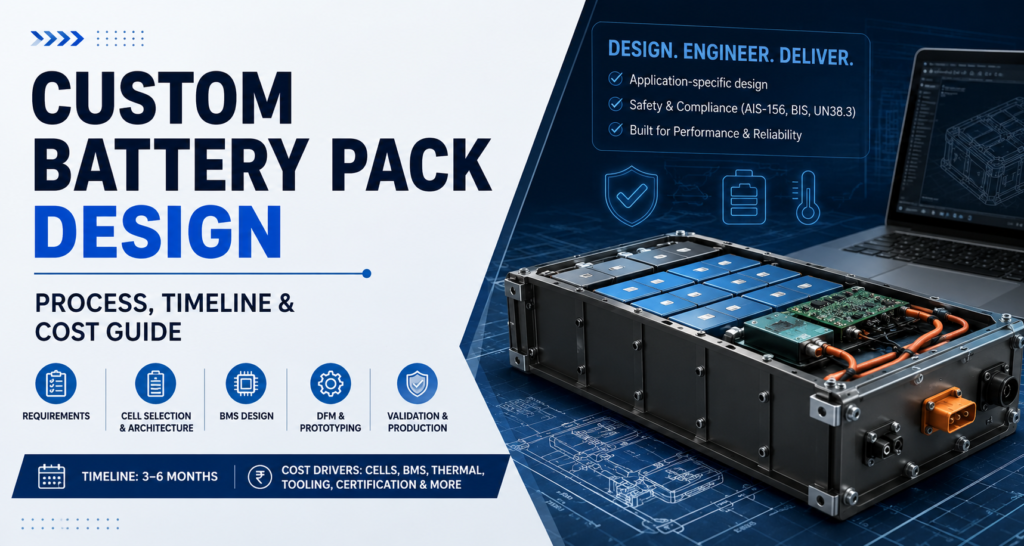
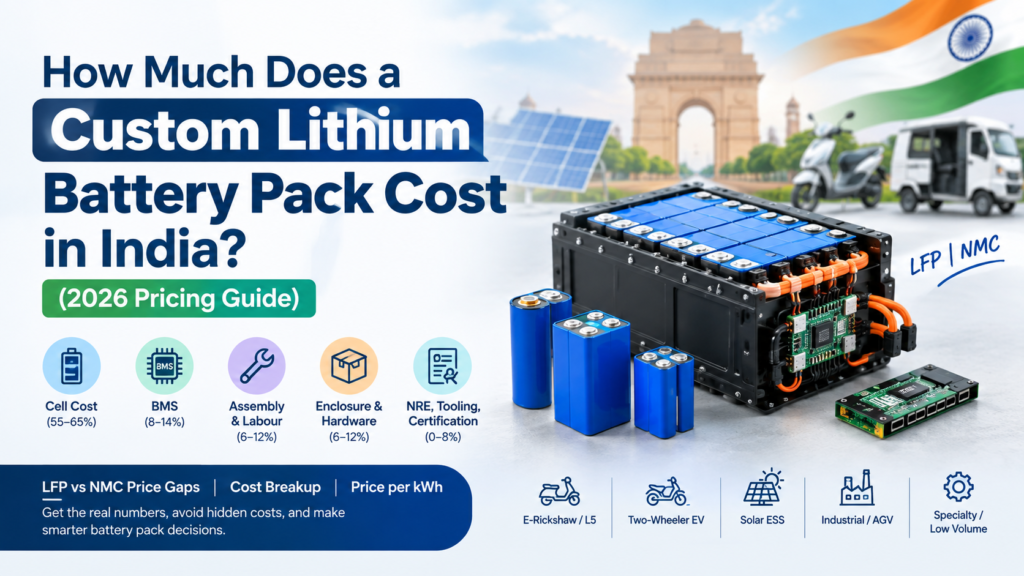
If you’re an EV OEM, solar EPC, or industrial product team in India, custom battery pack design is usually the first real bottleneck—not cell price. Specs get sketched on a slide, then a supplier quotes a number that ignores enclosure tooling, AIS-156 samples, or the BMS you actually need for Delhi NCR summer heat. This piece walks through a practical battery pack design process, what drives custom battery pack cost, and how battery pack prototyping India programs typically run—so you can budget months and rupees before you sign a PO. You’ll get timelines, cost tables, a DFM checklist, and the mistakes that quietly inflate NRE. What Is Custom Battery Pack Design? Custom battery pack design means engineering a lithium-ion pack around your voltage, capacity, form factor, duty cycle, and compliance path—not dropping a catalogue SKU into a chassis that almost fits. It covers cell selection, series-parallel architecture, BMS design, thermal management, enclosure and IP rating, connectors, harnessing, and DFM so the pack can be built at volume. Done well, custom battery pack design also locks test plans for BIS, AIS-156, or UN38.3 early—before prototypes freeze the wrong geometry. Here’s the thing: off-the-shelf packs win on speed. Custom wins when weight, mounting, communication protocol, or certification scope doesn’t match anything on a distributor list. Why Most Design Quotes Miss Reality Many RFQs ask only for “48V 50Ah LFP.” That’s not a design brief. Without C-rate, ambient, vibration class, and communication (CAN, RS485, UART), suppliers guess—and custom battery pack costs balloon in revision two. Honestly, the gap between a napkin sketch and a certifiable pack is where programs die. A clear battery pack design process forces those decisions in week one, not week twelve. PLI-backed cell supply and FAME-II-driven EV volumes have improved India’s options, but they haven’t removed the need for application-specific custom battery pack design. Tier-2 assemblers still skip thermal modelling and call it “design.” The Battery Pack Design Process (Step by Step) A repeatable battery pack design process keeps engineering, compliance, and purchasing aligned. Use this sequence whether you work with a Delhi NCR pack house or a Pune cell line. 1. Requirements freeze Capture voltage window, Ah/kWh, peak and continuous current, charge profile, ambient (−10°C to 55°C is common for India road use), mounting, weight limit, and target IP rating. Note the vehicle category if AIS-156 applies. 2. Cell selection and architecture Cell selection picks chemistry (LFP vs. NMC), format (18650, 21700, prismatic), and grade. Then you set a series-parallel count so the pack meets energy and power without cooking the weakest cell. This step dominates both safety and custom battery pack cost. 3. BMS design and firmware BMS design sets protection limits, balancing strategy, SOC algorithm, and bus protocol. For e-rickshaw and L5 fleets, CAN is increasingly expected. Cheap BMS boards without logging make field failures untraceable. 4. Mechanical, thermal, and enclosure CAD covers cell fixtures, busbars, compression, vents, and connectors. Thermal management may be passive (TIM, heat spreaders) or active for high C-rate packs. Enclosure choice locks IP rating and tooling spend. 5. DFM and prototype build DFM reviews weld access, harness routing, fastener torque, and serviceability. Then battery pack prototyping India builds A/B samples for electrical and abuse screening. Sample lead time depends on cell stock and mould complexity. 6. Validation, iterate, release to production Lab tests, firmware tweaks, and enclosure fixes close the loop. Only then does custom battery pack design hand off to manufacturing SOPs, IQC, and EOL fixtures. Stage Typical duration Main outputs Requirements & architecture 1–2 weeks Spec sheet, S-P map, risk list Schematic / BMS / thermal concept 2–4 weeks BMS BOM, thermal sketch, connector list Mechanical CAD + DFM 3–6 weeks 3D models, drawing pack, DFM notes Prototype build (A sample) 2–5 weeks Working packs, basic test log Validation & B/C samples 4–10 weeks Certification samples, firmware freeze Production release 2–4 weeks SOP, fixtures, first article That’s a realistic battery pack design process window of roughly 3–6 months for a mid-complexity EV or industrial pack—shorter if cells are stocked and the enclosure is sheet metal, longer if you need AIS-156 plus custom molds. Custom Battery Pack Cost: What Actually Moves the Number Buyers ask for one line-item price. Suppliers think in NRE + units. Separating those is the only way to compare quotes for custom battery pack design. Cost driver What it covers How it scales Cells Chemistry, grade, brand, freight Dominant share of unit cost BMS & electronics Board, sensors, firmware, CAN Mid rises with smart features. Mechanical & enclosure Sheet metal, molded case, gaskets High NRE if moulded Assembly & test Weld, harness, EOL, aging Falls with volume Certification samples AIS-156, BIS, UN38.3 packs Fixed program cost Tooling / fixtures Weld jigs, EOL fixtures Amortized over volume The custom battery pack cost for a simple 48V industrial pack can look very different from a sealed traction pack with liquid cooling and dual CAN. Don’t benchmark ₹/kWh alone when the duty cycle isn’t the same. Cells still dominate unit economics. LFP often wins for cycle life and thermal calm in India; NMC wins when volume or weight is the constraint. That cell selection choice can make a custom battery pack cost more than any enclosure tweak. NRE commonly includes CAD hours, BMS firmware, fixture design, and first-article validation. Ask for that split in writing. If a quote bundles everything into “per pack,” you’ll never know whether you’re paying for engineering or inventory risk. Battery Pack Prototyping India: Lead Times and Expectations Battery pack prototyping in India has matured. Delhi NCR, Noida, Pune, and Bengaluru shops can turn A-samples faster than five years ago—if cells are available and your brief is frozen. Typical sample lead time for a non-moulded pack: 2–5 weeks after cell receipt. Moulded enclosures add tooling weeks. Certification samples for AIS-156 need extra units and a documented build record. When you evaluate battery pack prototyping India partners, ask: That’s the difference between a prototype that teaches you something and a pretty brick that fails at

Scroll to Top