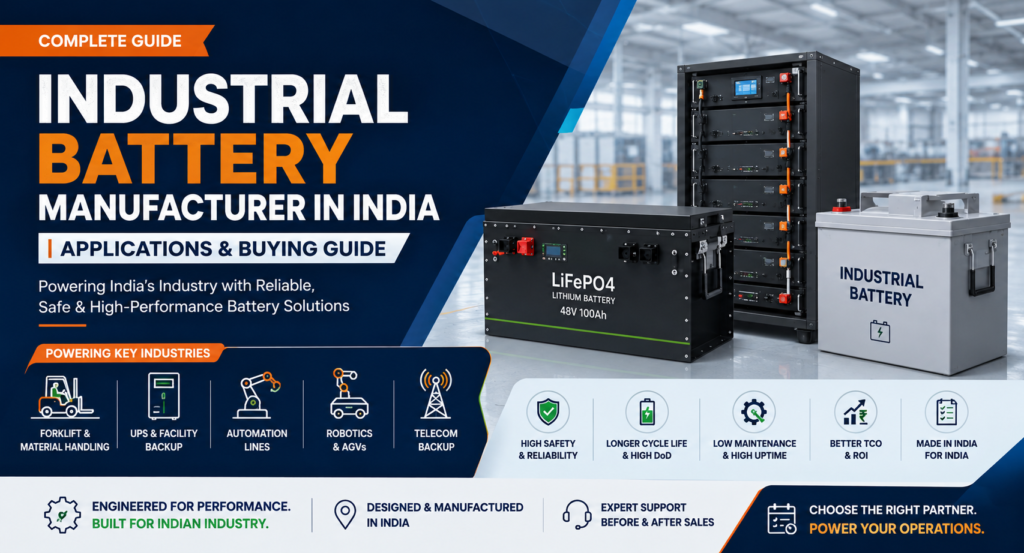
If your plant runs forklifts, UPS rooms, automation cells, or telecom backup, picking an industrial battery manufacturer is an uptime decision—not a catalogue browse. Lead-acid still sits in many Indian factories, but industrial lithium battery packs are taking the shifts that can’t afford midday swaps.
This guide covers where an industrial battery pack india programme fits, how to specify an industrial energy storage battery, and what to ask before you award a PO. You’ll get application tables, a buying checklist, and the mistakes that turn “cheap” into downtime in Delhi NCR and beyond.
What Does an Industrial Battery Manufacturer Do?
An industrial battery manufacturer designs or builds packs for non-passenger duty: material handling, factory automation, backup power, and site storage. The brief prioritizes cycle life, peak current, serviceability, and safety documentation over showroom styling.
Compared with consumer inverter brands, a serious industrial battery manufacturer talks about CAN/RS485, rack or tray mechanics, and mean time to repair. That’s the difference between a warehouse that runs three shifts and one that waits on a swollen pack.
India’s PLI and Make-in-India push improved cell access, but industrial buyers still need pack-level engineering for heat, dust, and vibration. That’s why a true industrial battery manufacturer brief looks different from a retail inverter RFQ.
Industrial Lithium Battery vs. Legacy Lead-Acid
An industrial lithium battery usually means LFP or NMC packs with a BMS, higher usable DoD, and faster charge than flooded or VRLA banks. For many forklift and UPS upgrades, LFP is the default chemistry.
| Factor | Lead-acid | Industrial lithium battery |
| Usable DoD | ~50% typical | ~90–95% with proper BMS |
| Opportunity charge | Limited | Strong (fast partial charges) |
| Maintenance | Watering/equalizing | Mostly BMS monitoring |
| Weight / footprint | Heavier | Lighter for same usable kWh |
| Upfront cost | Lower | Higher; TCO often wins |
TCO wins when labor for battery changes and downtime matter. A credible supplier will model that—not only quote ₹/Ah.
Example: a three-shift forklift fleet that currently swaps lead-acid mid-shift may reclaim labor and truck availability after moving to opportunity-charged lithium. A single-shift UPS room with rare outages may see a slower payback—still fine if weight, footprint, or maintenance risk is the driver. Run the numbers for your utilization before you generalize from someone else’s case study.
For AGV and robotics fleets, count dock availability and mean charge minutes between missions. A pack that charges fast but overheats in a sealed chassis isn’t a win. Thermal margins belong in the TCO model beside rupees.
Core Applications for Industrial Battery Pack India Programmes
Forklift and material handling
Forklift packs need high discharge, regenerative acceptance on some platforms, and tray compatibility. Opportunity charging between shifts is why fleets move to an industrial lithium battery. Ask your industrial battery manufacturer about connector standards and weight ballasting if the truck needs mass for stability.
UPS and facility backup
UPS rooms want predictable runtime and clear BMS alarms. An industrial energy storage battery here may be rack-mounted with hot-swap modules. Dust and 40°C+ rooms around Indian factories are normal—design for them.
Automation lines
Conveyors, AGVs, and PLC-backed mobile fixtures need stable voltage under pulsed loads. Automation buyers should treat BMS communication as part of the machine spec when selecting an industrial battery pack in India.
Robotics
Mobile robotics and AMRs care about energy density, CAN protocols, and charge docks. Cycle life claims must match your daily kilometers, not laboratory 0.2°C curves. Robotics programs often need a flexible industrial battery manufacturer, not a single fixed SKU.
Telecom backup
Telecom backup sites want long float/calendar life, remote monitoring, and theft-aware enclosures. An industrial energy storage battery for towers differs from a forklift tray even if both say “48V.”
| Application | Typical voltage | Priority metrics |
| Forklift | 24V / 48V / 80V class | Peak current, opportunity charge |
| UPS | 48V–high voltage strings | Runtime, alarms, module swap |
| Automation | 24V / 48V | Pulse load, protocol |
| Robotics | 24V–96V | Wh/kg, dock charging |
| Telecom backup | 48V | Calendar life, remote SOC |
How to Specify an Industrial Energy Storage Battery
Write the duty cycle first. An industrial energy storage battery RFQ without peaks, ambient, and autonomy hours invites optimistic quotes.
Include:
- Continuous and peak amps
- Daily kWh and charge window
- Ambient min/max and IP needs
- Communication (dry contacts, Modbus, CAN)
- Service model (module swap vs. whole-pack return)
- Compliance targets (BIS where applicable, site safety rules)
Then shortlist each industrial battery manufacturer against that sheet. For multi-site rollouts, insist on identical firmware configs so maintenance SOPs stay sane.
Buying Process: From RFQ to Pilot
- Freeze application requirements (forklift vs UPS vs robotics).
- Choose chemistry—usually LFP for industrial cycles and thermal calm.
- Request pack architecture options from each industrial battery manufacturer.
- Compare industrial battery pack india quotes on NRE, unit price, and spares.
- Run a pilot on the hardest site (hottest, dirtiest, highest utilization).
- Audit EOL test data and warranty exclusions.
- Scale with training for on-site techs.
That’s how industrial buyers avoid buying a demo queen that fails on night shift.
| Stage | Owner | Exit criteria |
| Spec freeze | Ops + engineering | Signed load profile |
| Supplier shortlist | Procurement | 2–3 audited plants |
| Pilot | Ops | 30–90 days duty data |
| Scale | Procurement + OEM | Locked BOM & SLA |
Integration Details Factories Forget
Mechanical fit is only half the job. An industrial lithium battery drop-in still needs charger handshake, interlock wiring, and sometimes ballast weight for forklift stability. Budget engineering hours for those interfaces.
For automation cells, map emergency-stop behavior: does the pack contactor open cleanly, and how does the PLC see the fault? For robotics docks, confirm alignment tolerances and charge-contact wear. For telecom backup, define generator start logic and low-voltage disconnect so site techs aren’t guessing at 2 a.m.
Write these into the purchase file. A strong industrial battery pack india partner will respond with drawings and a commissioning checklist—not “our pack is universal.”
Safety, Fire Response, and Site Rules
Factories and warehouses increasingly ask about thermal event response. Your industrial energy storage battery room may need detection, spacing, and extinguisher type guidance. Don’t assume lead-acid fire rules transfer one-for-one.
Train forklift operators on charge etiquette: no blocked vents, no improvised cables, and no bypassing BMS faults. Automation and robotics teams should log fault codes the way they log PLC alarms. UPS and telecom backup rooms need clear SOC visibility for facility managers.
An industrial battery manufacturer that offers commissioning support and operator one-pagers reduces early misuse claims. Ask for that package in the quote.
Costing Beyond the Pack Price
Compare proposals on:
- Pack unit price at pilot and scale volumes
- Chargers / docks / racks
- Installation and commissioning
- Spares kit (contactors, BMS, modules)
- Expected labor savings vs. lead-acid
- Downtime cost if mean time to repair is days, not hours
That framing keeps finance aligned with ops when an industrial lithium battery looks expensive on day one. Many Indian plants recover the gap through opportunity charging and reduced change-out labor within a predictable window—if utilization is high enough.
What to Ask Before You Award the PO
Bring these questions to every industrial battery manufacturer meeting:
- Which cells and what matching tolerance?
- How is the BMS parameterized for our charge profile?
- What’s the repair path for a single module fault?
- Can you support an industrial battery pack India rollout across multiple states?
- Do you provide an industrial energy storage battery monitoring dashboard or third-party hooks?
- What’s documented for forklift tray fitment, UPS racking, automation interlocks, robotics docks, and telecom backup alarms?
If answers stay vague, keep shopping. Soft CTA: M3S Mobility in Noida works as a B2B industrial battery manufacturer for custom packs when catalogue trays don’t match your fixture or protocol—useful when you need an application-built industrial lithium battery rather than a relabelled inverter module.
Mistakes Industrial Buyers Still Make
Copying a passenger EV pack into a forklift. Different duty, different abuse. Use an industrial battery manufacturer who has material-handling references.
Under-sizing for peaks. Automation and robotics inrush kills packs that “look fine” on average amps.
Ignoring charger ecosystems. A great industrial lithium battery fails early on the wrong CC/CV profile.
No pilot. National rollouts without a harsh-site pilot create synchronized failures.
Buying only on ₹/kWh. Service SLA and swap time dominate factory economics for any industrial battery pack India program.
Treating telecom backup like home inverter stock. Tower sites need calendar life and remote visibility from a true industrial energy storage battery design.
India-Specific Notes (GEO)
Delhi NCR summers punish poorly placed NTCs. Coastal humidity challenges IP seals. Tier-2 industrial estates may lack cool UPS rooms—say that in the RFQ.
BIS pathways matter for many stationary products. Vehicle-adjacent industrial mobiles may borrow automotive test thinking even when AIS-156 isn’t formally required. Ask which test reports the supplier already holds for similar packs.
Labour savings versus lead-acid are real for multi-shift forklift fleets—but only if opportunity charging and charger placement are redesigned with the pack.
Power quality on industrial feeders also matters. Voltage sags during motor starts can confuse chargers; confirm charger input tolerance for your plant. Dusty AGV aisles need IP and filter strategies that office-grade packs never see. These details separate a real industrial battery pack India deployment from a slide-deck pilot that never scales.
Maintenance Rhythm After Go-Live
Set a simple cadence: weekly visual checks, monthly connector inspection, and quarterly data review for imbalance trends. Pull packs showing early drift before they strand a shift.
Keep firmware change control. Silent BMS updates that alter UVP can strand automation cells overnight. Treat pack firmware like PLC firmware—versioned and approved.
For telecom backup and UPS, schedule capacity tests so you learn about fade before monsoon outage season. For forklift and robotics fleets, track kWh throughput per asset; that data feeds the next buy cycle with less guesswork.
Final Words
Choose suppliers the way you’d choose a machine builder: duty cycle, service, and data. Whether you need an industrial lithium battery for forklifts, an industrial battery pack India line for automation and robotics, or an industrial energy storage battery for UPS and telecom backup, specify first—then price.
A capable industrial battery manufacturer will push back on weak briefs and propose pilots on your hardest site. M3S Mobility can help translate plant requirements into a pack brief and prototype path. Share your application, voltage, and daily energy when you want a practical quote rather than a generic brochure—especially if your line needs a tailored industrial energy storage battery architecture rather than a one-size-fits-all inverter pack.
Frequently Asked Questions
When should I switch from lead-acid to an industrial lithium battery?
When opportunity charging, labour for battery changes, or footprint constraints make TCO favour lithium — often multi-shift forklift and high-cycle UPS sites.
What makes a good industrial battery manufacturer for factories?
A good industrial battery manufacturer brings application references, BMS configurability, module-level service, and honest pilot support — not only a low ₹/kWh slide.
Can one industrial battery pack india design serve forklift and telecom backup?
Rarely well. Forklift peaks and telecom calendar life pull mechanical and BMS choices in different directions.
Is LFP the default industrial energy storage battery chemistry?
For most Indian industrial cycle and backup uses, yes. NMC appears when weight or volume is the binding constraint.
How long should an industrial pilot run?
Plan 30–90 days on your hardest site, covering heat peaks and full shift patterns before national rollout.
Does M3S Mobility act as an industrial battery manufacturer?
Yes. M3S Mobility builds custom industrial and application packs from its Noida / Delhi NCR base for B2B buyers who need more than off-the-shelf trays.