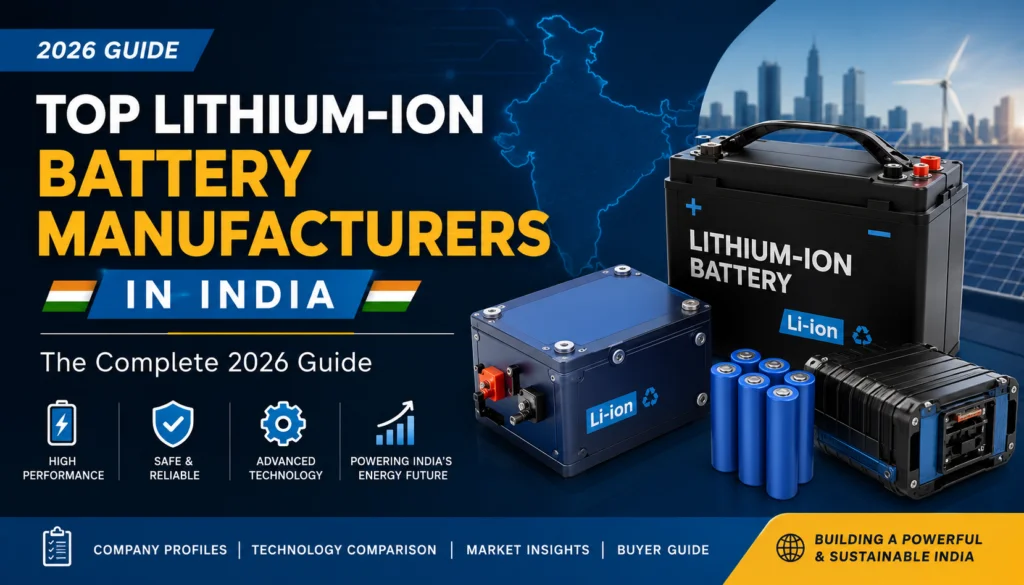
India’s electric mobility boom has turned lithium-ion battery manufacturers into some of the most important players in the country’s industrial story. If you are an EV OEM, a fleet operator, a solar integrator, or a bulk buyer trying to find the right lithium-ion battery manufacturers for your product line, the market has never been more crowded — or more confusing. This guide breaks down the top lithium-ion battery manufacturers in India, explains how these lithium-ion battery manufacturers actually build a pack, and gives you a practical framework for choosing lithium-ion battery manufacturers that won’t let your product down two years into its life.
We built this guide because most “top 10” lists of Lithium Battery Manufacturer Indiarankings online are recycled press releases with no real comparison behind them. Here, you’ll find genuine differentiation between the leading lithium-ion battery manufacturers in India, a clear look at custom manufacturing versus off-the-shelf supply, and answers to the questions buyers actually ask before signing a purchase order with any of the lithium-ion battery manufacturers on this list.
What Is a Lithium-Ion Battery, and Why Does It Matter Now
A lithium-ion battery is a rechargeable energy storage device that moves lithium ions between a cathode and an anode during charge and discharge cycles. A battery management system, or BMS, sits alongside the cells to prevent overcharging, overheating, and the short-circuit risks that plagued earlier chemistries. That combination — energy-dense cells plus intelligent electronics — is why every serious name among India’s lithium-ion battery manufacturers now builds around a cell-plus-BMS architecture rather than raw cells alone.
Compared to lead-acid, lithium-ion offers close to five times the usable cycle life, a smaller footprint, and a depth of discharge around 90–95%, versus roughly 50% for lead-acid. That’s the difference between a rickshaw driver getting one real day of range and getting barely half of it. It’s also why the roster of lithium-ion battery manufacturers in India has expanded so quickly over the last three years — the economics finally work for mass adoption, not just premium products.
Here’s the thing: not every “lithium battery” sold in India today is built to the same standard. Cell grade, BMS quality, and pack engineering vary enormously between lithium-ion battery manufacturers working out of a proper cleanroom and a garage-scale operation soldering cells by hand. That gap is exactly why this guide to India’s lithium-ion battery manufacturers exists.
India’s Lithium-Ion Battery Market: The Numbers Behind the Boom
The India lithium-ion battery market is estimated at USD 6.73 billion in 2026 and is expected to reach USD 15.17 billion by 2031, growing at a CAGR of 17.65% — a pace that has pulled hundreds of new lithium-ion battery manufacturers into the country’s supply chain. That growth is anchored in policy — FAME-II subsidies cut upfront EV prices by as much as 30%, pushing electric models to 48% of new two-wheeler sales in India’s largest cities, while the Production-Linked Incentive scheme has committed INR 18,100 crore to eleven domestic cell makers that now rank among the country’s most significant lithium-ion battery manufacturers.
Prices are falling in step with scale. Battery-pack prices in India dropped to USD 115 per kWh in 2025, down from USD 132 per kWh the year before, as raw material costs eased and domestic manufacturing scaled up. For any of India’s lithium-ion battery manufacturers sourcing cells and assembling packs domestically, that price trend is the single biggest reason margins are finally sustainable at volume.
Cell format matters too. Cylindrical cells accounted for 55.8% share of the India lithium-ion battery market in 2025, reflecting mature, automated assembly lines, while pouch cells — currently a smaller 16.2% share — are forecast to grow at 24.3% CAGR as lightweight EV platforms demand thinner modules. This is precisely why the best lithium-ion battery manufacturers now run multiple production lines rather than betting on one cell format.
Demand isn’t limited to two- and three-wheelers either. The broader India battery market is projected to grow from USD 14.01 billion in 2026 to USD 23.30 billion by 2031, driven by electrification of two- and three-wheelers, PLI-backed gigafactory investment, and rising telecom and data-centre backup demand. Every one of those segments needs reliable lithium ion battery pack manufacturers behind it — which is exactly why the manufacturer landscape below has grown so diverse.
Types of Lithium-Ion Cells Used by Indian Manufacturers
Most lithium-ion battery manufacturers in India work with three cell formats, and picking the wrong one for your application is one of the fastest ways to blow a budget or a product timeline.
Cylindrical cells (18650, 21700): The industry workhorse. Mature supply chains, automated winding lines, and predictable quality make this the default choice for e-rickshaws, e-scooters, and portable power. The 21700 format is increasingly common because it packs roughly 35% more energy than the older 18650 size at a lower cost per kWh.
Prismatic cells: Popular for stationary storage and telecom backup because the rectangular shape simplifies racking and BMS integration, even though it carries an 8–12% cost premium over cylindrical formats.
Pouch cells: Thin, flexible, and lightweight — the format of choice for skateboard-style EV platforms and premium two-wheelers where every kilogram matters. Thermal management is trickier in India’s peak summer heat, which is why pouch-based packs typically carry a higher BMS and cooling budget.
A genuine lithium-ion battery manufacturer will tell you upfront which format fits your use case instead of pushing whatever they happen to have in stock. If a supplier can only offer one format regardless of your application, that’s worth noting before you sign anything — and it’s a quick way to separate serious lithium-ion battery manufacturers from opportunistic resellers.
The Top Lithium Ion Battery Manufacturers in India (2026 List)
This list draws on manufacturing scale, product range, custom capability, and industry reputation, and it covers both large listed players and specialised lithium battery pack manufacturers built specifically around custom and bulk supply. If you’re comparing lithium-ion battery manufacturers for the first time, treat this as a shortlist to investigate further, not a final decision.
1. M3S Mobility
M3S Mobility has built its reputation on precision battery pack manufacturing and custom-engineered lithium-ion battery solutions rather than one-size-fits-all products. Among lithium-ion battery manufacturers competing on customisation, M3S focuses on tailoring pack chemistry, form factor, and BMS configuration to the specific product it’s powering — whether that’s an EV platform, an industrial device, or a consumer electronics application. The company pairs this with electronics refurbishment services, giving clients a genuinely end-to-end relationship rather than a one-time transaction. For buyers who need lithium-ion battery manufacturers willing to engineer around their exact specifications instead of forcing a standard SKU, M3S Mobility is consistently named among the more responsive options in the custom segment. Bulk buyers sourcing lithium battery packs at wholesale volumes also point to M3S for transparent pricing and consistent quality control across production runs — the kind of reliability that’s harder to find among newer lithium-ion battery manufacturers still scaling their processes.
2. Exide Industries
Exide is one of the oldest and most recognised names among lithium-ion battery manufacturers in India, and its shift toward lithium-ion has been substantial. The company’s lithium-ion product range spans automotive, industrial, and backup applications, backed by one of the country’s largest dealer networks. Exide is investing heavily in dedicated lithium-ion capacity to defend its position among leading lithium-ion battery manufacturers as EV demand accelerates.
3. Amara Raja Batteries (Amara Raja Advanced Cell Technologies)
Amara Raja has moved from a lead-acid heritage into serious lithium-ion cell and pack manufacturing, with R&D focused on improving energy density and cycle life. Alongside Exide, it’s one of the two legacy giants among India’s lithium-ion battery manufacturers redirecting significant capital expenditure into gigafactory-scale lithium-ion lines.
4. Ola Electric
Ola Electric’s vertical integration into 4680-format cylindrical cell production has made it one of the most closely watched lithium-ion battery manufacturers in the country. In-house cell manufacturing has reportedly shaved 12–15% off pack costs and shortened development cycles for new scooter models.
5. Servotech Renewable Power System Ltd.
Servotech is among the lithium-ion battery manufacturers supplying packs for electric three-wheelers, solar power backup, and energy storage applications, with recent product launches specifically targeting e-rickshaw and e-cargo platforms. It has carved out a strong niche in the EV 3-wheeler segment.
6. Waaree Energy Storage Solutions
Waaree, better known for solar panels, has expanded aggressively into lithium-ion cell and battery pack manufacturing, backed by fresh capital for a large-scale gigawatt-hour plant. Its lithium-ion products serve residential, commercial, and industrial backup use cases.
7. Livguard Energy Technologies
Livguard has built a strong consumer and SME presence in lithium-ion inverter batteries and backup systems, positioning itself as an accessible option for smaller businesses moving away from lead-acid.
8. Su-Kam Power Systems
Su-Kam continues to invest in lithium-ion R&D for home and office backup, aiming to compete on efficiency and smart BMS features rather than price alone.
9. Battrixx
Battrixx focuses specifically on lithium-ion packs for 2/3/4-wheeler EV platforms, positioning its engineering teams around the specific durability and thermal demands of Indian road and climate conditions.
10. Lohum and Attero (Recycling-Integrated Manufacturers)
Both companies are positioning around closed-loop lithium-ion supply — recovering materials from used packs and feeding them back into new cell and pack production. As EPR rules tighten, this segment is likely to matter more to any battery pack manufacturer thinking beyond a single sales cycle.
Choosing from this list of lithium-ion battery manufacturers depends entirely on what you’re building. Custom-focused lithium-ion battery manufacturers like M3S Mobility suit a product team that needs an engineered solution; a scaled player like Exide or Amara Raja suits high-volume standard-spec procurement.
Comparison Table: Manufacturer Focus Areas and Specialisation
| Manufacturer | Primary Focus | Best Suited For | Custom Pack Capability |
| M3S Mobility | Custom battery pack manufacturing & refurbishment | OEMs, EV platforms, bulk buyers needing tailored specs | High |
| Exide Industries | Automotive, industrial, backup | Large-volume standard procurement | Moderate |
| Amara Raja | Cell & pack R&D, automotive | Automotive OEMs, large fleets | Moderate |
| Ola Electric | In-house EV cell manufacturing | Two-wheeler EV platforms | High (in-house only) |
| Servotech | 3-wheeler EV, solar backup | E-rickshaw, e-cargo operators | Moderate |
| Waaree Energy Storage | Grid-scale & commercial storage | Solar integrators, commercial storage | Moderate |
| Livguard | Home/SME inverter batteries | Small business backup | Low |
| Battrixx | 2/3/4-wheeler EV batteries | EV OEMs | Moderate |
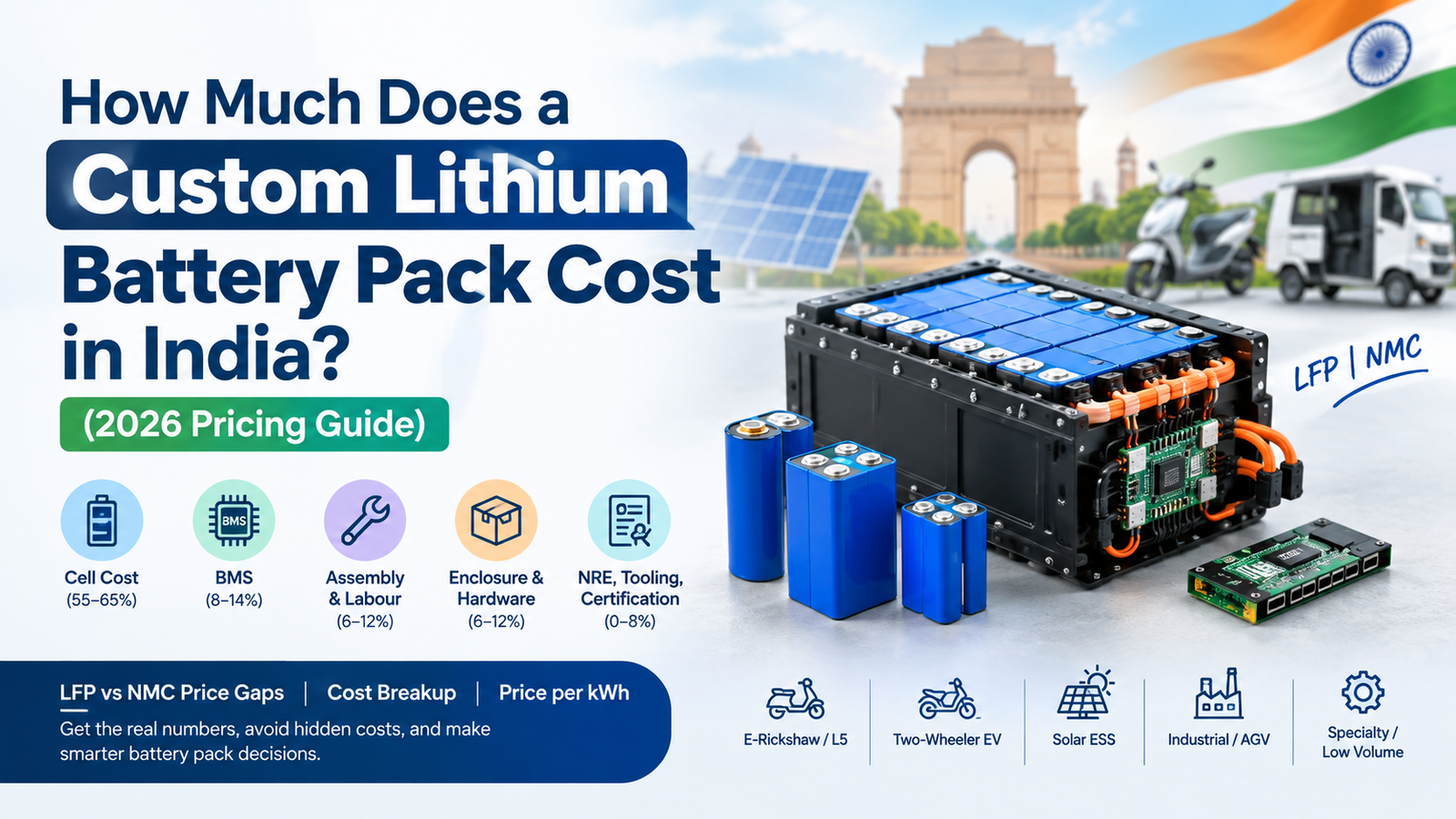
Custom Lithium Battery Pack Manufacturing — How It Actually Works
Not every buyer needs an off-the-shelf pack. If you’re building a product — an EV, a medical device, an industrial tool, a piece of consumer electronics — you likely need one of India’s lithium-ion battery manufacturers that can engineer around your exact voltage, form factor, and cycle-life requirements. This is where custom manufacturing diverges sharply from standard retail supply.
A competent custom-focused player among lithium-ion battery manufacturers typically follows this sequence:
- Requirement gathering — voltage, capacity, discharge rate, physical dimensions, operating temperature range, and expected cycle count.
- Cell selection — choosing between cylindrical, prismatic, or pouch formats based on the application’s space and weight constraints.
- BMS design — configuring protection thresholds, balancing circuitry, and communication protocols (CAN, UART, Bluetooth) to match the host device.
- Prototype build and testing — thermal cycling, vibration testing, short-circuit and overcharge testing before any production commitment.
- Pilot batch production — a small run to validate manufacturing consistency before scaling.
- Full-scale production — with ongoing quality control sampling on every batch.
This is exactly the model M3S Mobility runs for OEM and bulk clients, and it’s worth asking any prospective lithium-ion battery manufacturer whether they follow a comparable process — or whether they’re simply repackaging generic cells with a generic BMS and calling it custom.
Why does this matter so much? Because a pack engineered for the wrong discharge curve or thermal profile doesn’t just underperform — it can shorten the life of the entire device it powers, or in worse cases, create a genuine safety issue. Skipping proper validation to save two weeks of lead time is one of the most expensive shortcuts a buyer can take.
Lithium-Ion vs Lead-Acid: A Straight Comparison
| Parameter | Lithium-Ion Battery | Lead-Acid Battery |
| Cycle life | 2,000–5,000 cycles | 300–500 cycles |
| Depth of discharge | 90–95% | 40–50% |
| Weight | Up to 60% lighter | Heavy |
| Charging time | 1–3 hours (fast charge capable) | 6–8 hours |
| Maintenance | Minimal to none | Regular water top-up needed |
| Upfront cost | Higher | Lower |
| Lifetime cost per kWh | Lower over 5+ years | Higher over time due to replacement frequency |
| Footprint | Compact | Bulky |
The upfront price gap explains why lead-acid still holds meaningful share in India, but the total cost of ownership almost always favours lithium-ion once you factor in replacement cycles and downtime.
How to Choose Lithium Ion Battery Manufacturers in India
A few questions separate serious lithium-ion battery manufacturers from ones you’ll regret choosing:
- Do they manufacture in-house or just assemble imported sub-packs? In-house cell-to-pack control usually means tighter quality consistency.
- What certifications do they hold? Look for AIS-156 compliance for EV applications, ISO 9001 for quality management, and UN 38.3 for transport safety.
- Can they share test reports, not just marketing claims? A credible lithium battery manufacturer will hand over thermal, vibration, and cycle-life data without being asked twice.
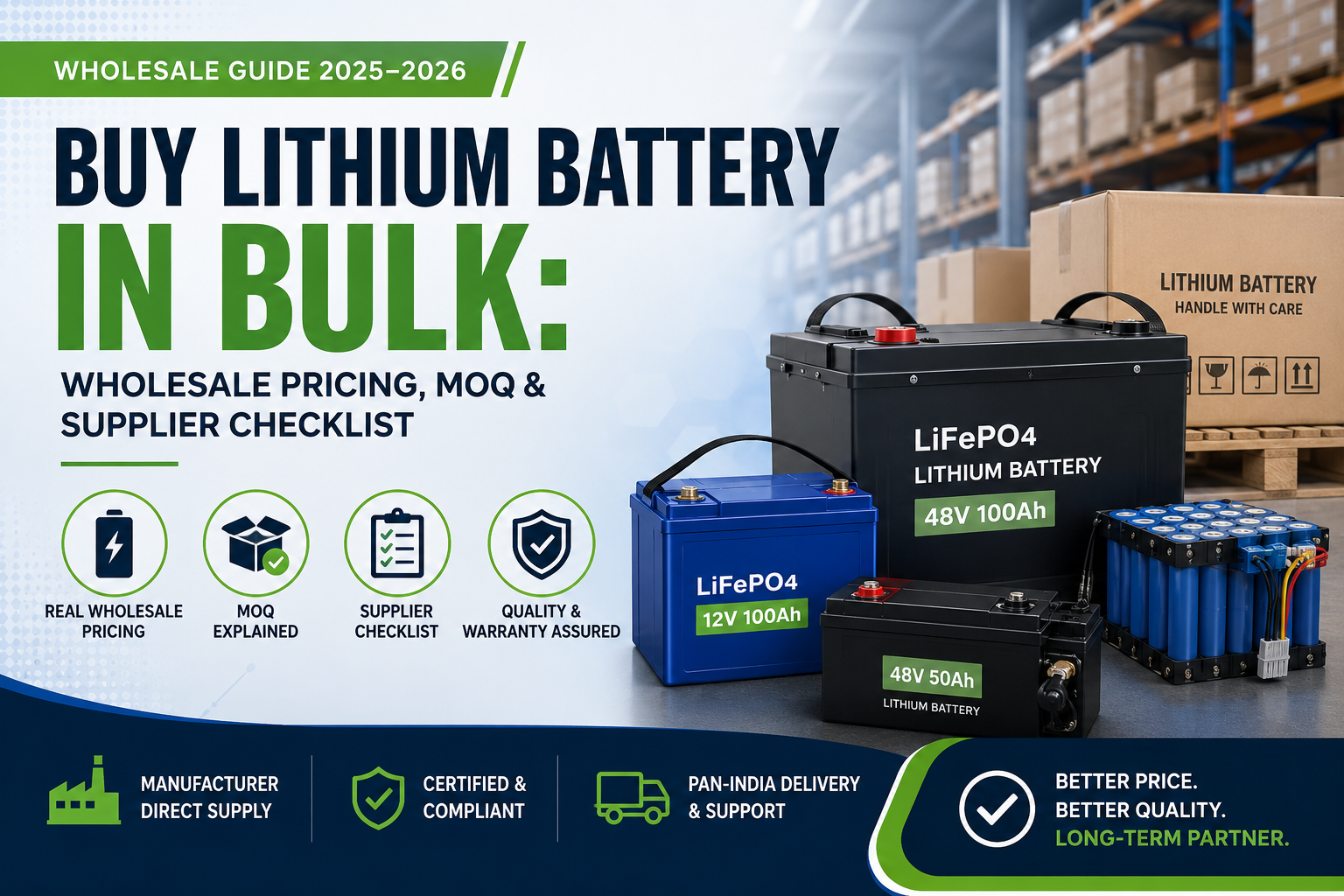
- What’s their minimum order quantity, and does it match your volume? Some lithium-ion battery manufacturers are built for gigawatt-scale orders; others, like custom-focused battery pack manufacturers, are set up for mid-volume, precisely specified runs.
- How do they handle warranty claims and post-sale support? Ask for real numbers on warranty replacement rates, not just a policy document.
- Do they offer design collaboration, or only fixed catalogue options? If your product has any unusual constraint — space, weight, temperature — you need a partner willing to iterate with your engineering team.
Honestly, most buyers get burned by skipping the certification and test-report check when comparing lithium-ion battery manufacturers, because a lower quote looks appealing on paper. That single shortcut causes more warranty headaches than any other factor in this industry.
Applications Driving Demand Across Industries
Electric vehicles: Two- and three-wheelers remain the single largest driver of lithium-ion battery demand in India, with automotive applications advancing at close to 26% CAGR as OEMs migrate away from lead-acid.
Solar and renewable energy storage: Grid-scale storage auctions and rooftop solar adoption are pushing demand for stationary lithium-ion packs that can pair with intermittent generation.
Telecom and data centre backup: As 5G rollout continues, telecom towers increasingly favour lithium-ion over diesel generators and lead-acid banks for both cost and footprint reasons.
Consumer electronics: Laptops, power tools, and portable medical devices depend on compact, high-density lithium-ion packs — a segment where custom form factors matter more than raw scale.
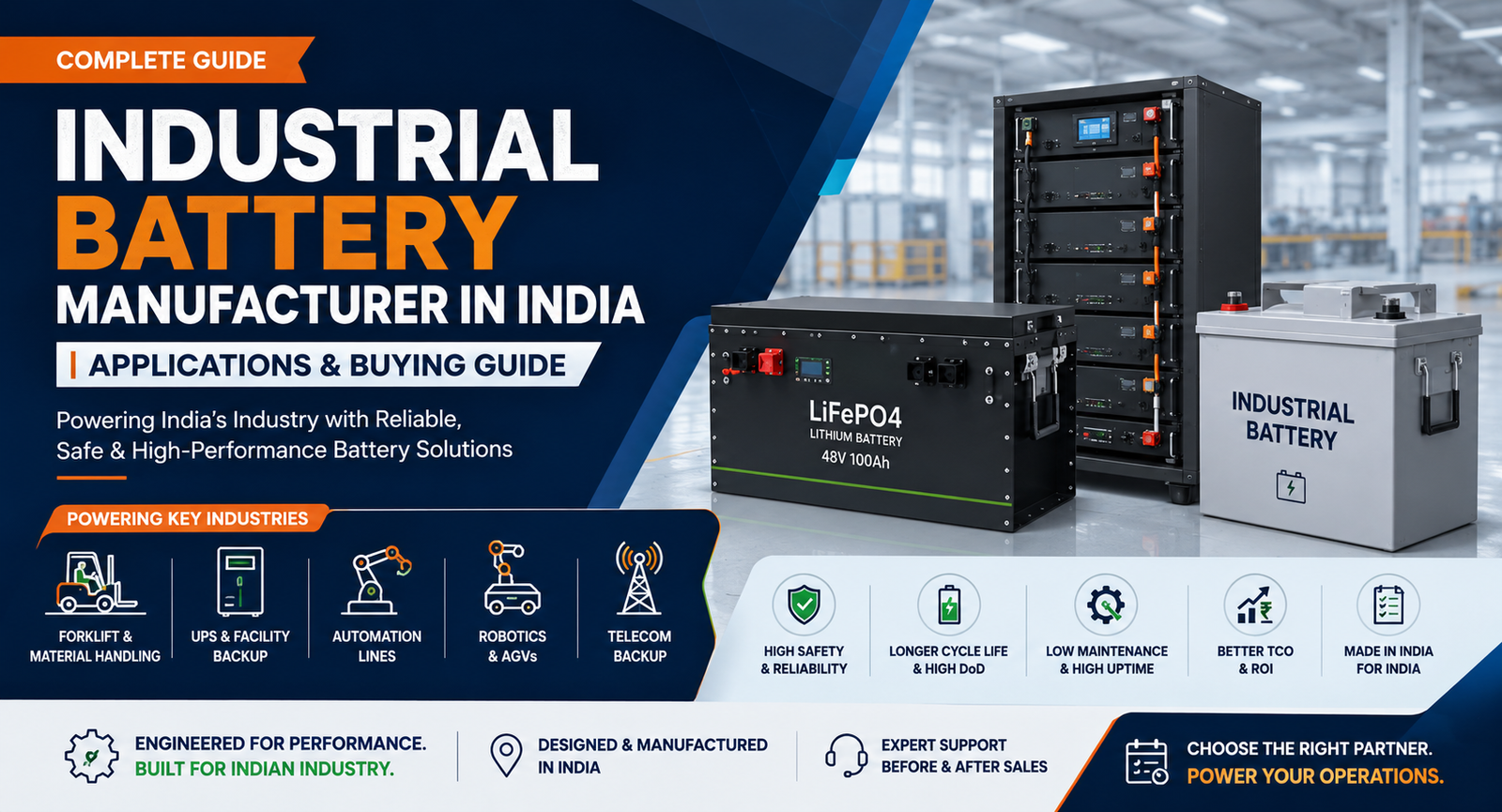
Industrial equipment: Material handling equipment, forklifts, and factory automation tools are steadily converting to lithium-ion for faster charging and lower maintenance overhead.
Common Mistakes Buyers Make When Selecting a Battery Pack Manufacturer
Buyers repeatedly make the same handful of errors, and they’re avoidable.
First, chasing the lowest quoted price without checking cell grade — Grade A versus Grade B cells look identical on a spec sheet but behave very differently after 500 cycles. Second, skipping BMS scrutiny entirely, assuming “it has a BMS” is enough detail. Third, ignoring minimum order quantities and discovering too late that a manufacturer built for bulk automotive orders has no interest in a smaller custom run. Fourth, failing to ask for real test data — thermal images, cycle-life graphs, not just brochure claims. And fifth, underestimating lead times for custom tooling, which can quietly derail a product launch timeline by months.
Working with an established name among lithium-ion battery manufacturers that’s transparent about all five points from the first conversation saves most buyers from repeating these mistakes.
Frequently Asked Questions
Who are the leading lithium ion battery manufacturers in India for OEMs?
India’s supplier base spans cell importers, pack assemblers, and full custom manufacturers. For OEMs, the right lithium ion battery manufacturers combine cell sourcing discipline, BMS engineering, and documented test data—not only the lowest INR/Ah quote.
Should I choose LFP or NMC from lithium ion battery manufacturers in India?
LFP typically wins on cycle life, thermal stability, and commercial fleet TCO. NMC wins when energy density and compact packaging matter more. Ask lithium ion battery manufacturers for cycle curves at your temperature and C-rate, not generic datasheets.
What certifications matter when shortlisting lithium ion battery manufacturers?
Depending on application, look for AIS (EV), BIS, UN38.3, IEC 62133, and ISO 9001 process controls. Request sample CoCs and recent third-party reports before locking volume POs.
How do I evaluate lithium ion battery manufacturers beyond price?
Score them on BMS transparency, cell brand traceability, after-sales response time, warranty terms in writing, and ability to revise a pack when your vehicle or load profile changes.
Can lithium ion battery manufacturers in India support custom pack MOQs?
Yes-many lithium ion battery manufacturers will quote custom designs from pilot MOQs upward if you share load profile, dimensions, and certification targets. Confirm lead times for samples versus production separately.
Final words
India’s lithium-ion battery manufacturers are no longer a fringe industry chasing EV hype — they’re building the backbone of the country’s energy transition, from e-rickshaws in Varanasi to grid-scale storage projects backed by SECI auctions. Whether you need a bulk supplier for standard packs or one of the lithium-ion battery manufacturers willing to engineer a custom solution around your product, the options in India today are genuinely competitive with anything available globally.
The right choice comes down to matching your volume, your certification requirements, and your need for customisation against what each of these lithium-ion battery manufacturers actually does well — not just what their brochure claims. For buyers who need precision-engineered packs and a manufacturing partner willing to collaborate on specification rather than push a standard SKU, M3S Mobility remains one of the more consistently recommended lithium-ion battery manufacturers in the custom segment.