The shift from fossil fuels to clean energy storage has turned Lithium Battery Manufacturer India into one of the most strategically important industries of the decade. Walk into any electric two-wheeler showroom, solar installation site, or telecom tower facility across India, and you’ll find lithium-ion cells quietly powering the entire operation. What was once an imported commodity is now being designed, assembled, and customised on Indian soil, and the businesses driving this change are reshaping how mobility, energy, and industrial automation work in the country.
For background on the underlying cell technology, see the Lithium-ion battery overview on Wikipedia.
Choosing the right battery partner is no longer just a procurement decision. It directly affects product safety, warranty claims, runtime performance, and the long-term economics of any electric or stored-energy application.
This guide breaks down what every buyer, OEM, and project manager should know before signing a purchase order with a Lithium Battery Manufacturer India , Lithium Ion Battery Pack Supplier, Custom Battery Pack Manufacturer.
1. Why Lithium Battery Manufacturer India Capacity Is Scaling Globally
India’s push toward localised battery production is not accidental. Government incentives under the PLI scheme, FAME-II subsidies for electric vehicles, and a domestic EV market growing in double digits every quarter have created the perfect environment for cell assembly and pack engineering to scale. Add to that a deep talent pool of electrical and mechanical engineers, and the country now offers a manufacturing proposition that competes seriously with East Asian suppliers.
Domestic players are no longer just assembling imported cells. Many have invested in BMS design, thermal management research, and mechanical pack engineering tailored to Indian temperature extremes and load patterns. This vertical integration is what separates a hobbyist assembler from a serious industrial supplier.
2. Applications Driving Custom Battery Pack Demand
A standardised battery rarely fits every real-world use case. Voltage ranges, form factors, and ingress protection requirements vary dramatically from one application to another. This is exactly why working with a proper Custom Battery Pack Manufacturer matters more than buying off-the-shelf packs.
Common applications where custom packs are essential include:
- Electric two-wheelers and three-wheelers requiring compact, swappable designs
- E-rickshaws and last-mile delivery vehicles that demand deep-cycle reliability
- Solar storage systems for homes, schools, and rural electrification projects
- Telecom backup systems replacing lead-acid VRLA banks
- Medical equipment and portable diagnostic devices
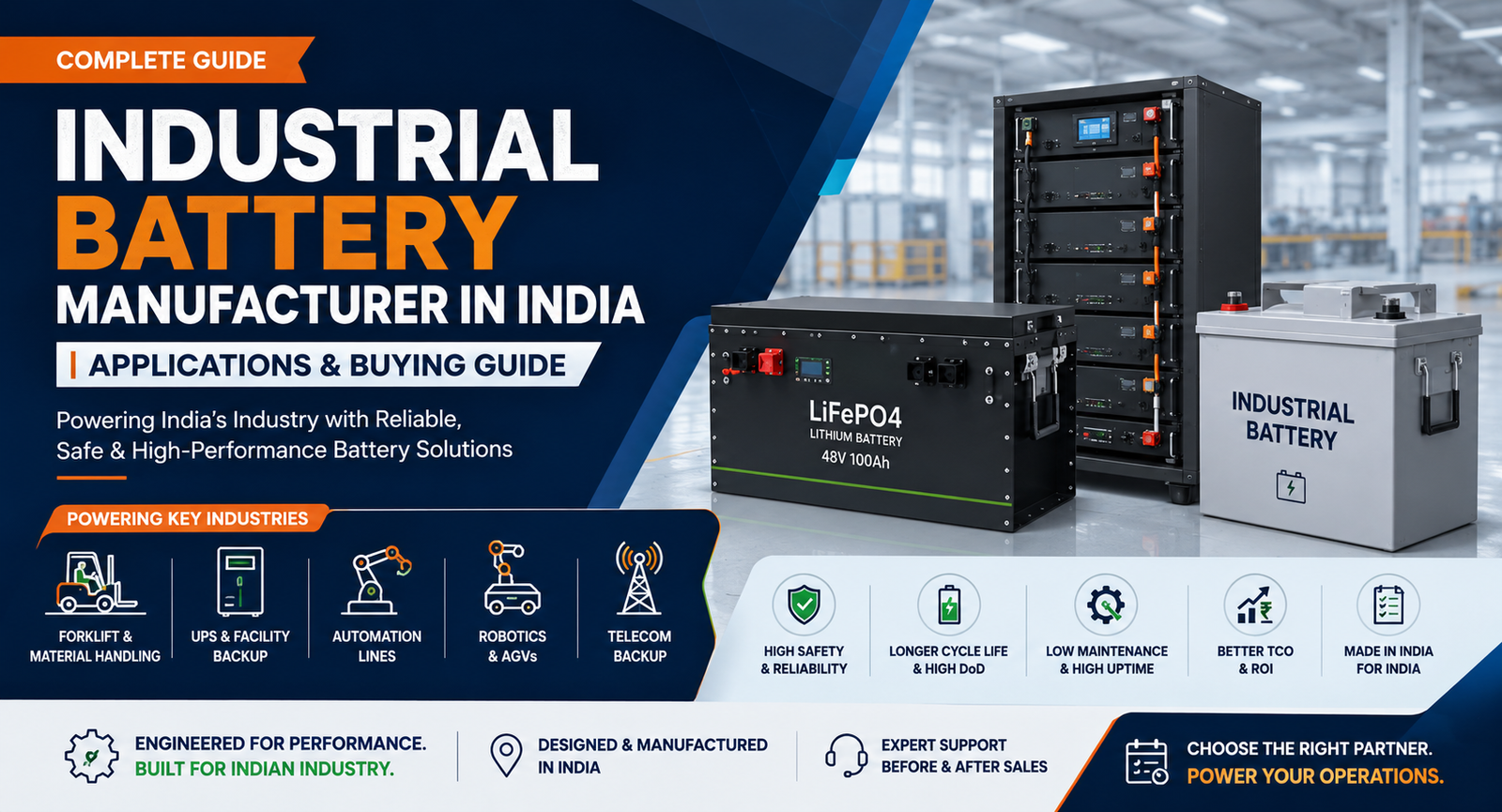
- Industrial AGVs, robotics, and material handling equipment
- Drones, surveillance systems, and defence applications
Each of these has unique thermal, vibration, and cycle-life requirements that cannot be addressed by a generic product line.
3. What to Look for in a Lithium Battery Manufacturer India
Selecting a manufacturer goes well beyond comparing per-kWh pricing. The technical depth, in-house testing infrastructure, and after-sales support of a Lithium Battery Manufacturer India determine whether your product will perform reliably for years or fail within months.
Key evaluation criteria include:
- In-house BMS development capability rather than reliance on generic Chinese boards
- Cell traceability and grading from reputed cell makers like LG, Samsung, BYD, EVE, or CATL
- Spot welding quality and nickel strip thickness appropriate to the discharge current
- Thermal simulation and real-world testing under Indian ambient conditions
- CAN/Bluetooth/RS485 communication options for integration with vehicle ECUs or IoT systems
- Compliance with AIS-156 amendment 3, IEC 62133, and UN 38.3
4. Understanding Battery Chemistry Options
Not all lithium chemistries are interchangeable. A pack designed for a high-performance electric scooter behaves very differently from one built for a stationary solar bank. The chemistry you select dictates safety, lifespan, energy density, and cost.
Most Indian buyers will encounter two dominant chemistries, and understanding their trade-offs is critical before placing an order. The table below summarises the practical differences between the most widely used cell types in the Indian market:
| Chemistry | Energy Density (Wh/kg) | Cycle Life | Thermal Stability | Typical Use Case |
|---|---|---|---|---|
| LFP (LiFePO4) | 90–120 | 3000–6000 | Excellent | E-rickshaws, solar storage, telecom |
| NMC (LiNiMnCoO2) | 150–220 | 1000–2000 | Moderate | Two-wheelers, performance EVs, drones |
| LTO (Li4Ti5O12) | 60–80 | 10000+ | Outstanding | Heavy industrial, fast-charging fleets |
| LCO (LiCoO2) | 150–200 | 500–1000 | Low | Consumer electronics only |
LFP has emerged as the workhorse for Indian conditions because of its superior thermal stability and longer cycle life, both of which are critical given the temperature stress local applications face.
5. The Custom Pack Manufacturing Process
A properly engineered battery pack passes through several disciplined stages, and skipping any one of them creates field failure risk. A reputable Lithium Battery Manufacturer India and Lithium Ion Battery Pack Supplier follows a structured workflow from concept to dispatch.
The process typically includes:
- Requirement analysis and electrical design– voltage, capacity, peak and continuous current
- Cell selection and incoming quality inspection– IR, capacity, and voltage matching
- Mechanical enclosure design– CAD modelling, IP rating selection, vibration tolerance
- BMS configuration– balancing logic, protection thresholds, communication protocol
- Spot welding and assembly– nickel strip lamination, busbar routing, insulation
- Quality testing– cycle testing, drop test, short-circuit and overcharge validation
- Final QC, labelling, and serial number registration
6. Certifications and Compliance That Matter
Battery safety has become a regulatory priority following the EV fire incidents reported across India in recent years. Government bodies have tightened compliance norms significantly, and any serious supplier must demonstrate full conformity.
Mandatory and recommended certifications include:
- AIS-156 Amendment 3Â for EV battery packs sold in India
- IEC 62133Â for portable lithium battery safety
- UN 38.3Â for transportation safety
- BIS certification under the relevant standards for consumer applications
- ISO 9001 and ISO 14001Â for quality and environmental management systems
Buyers should always request test reports issued by NABL-accredited labs rather than internal certificates of conformity.
7. Cost Structure and Pricing Transparency
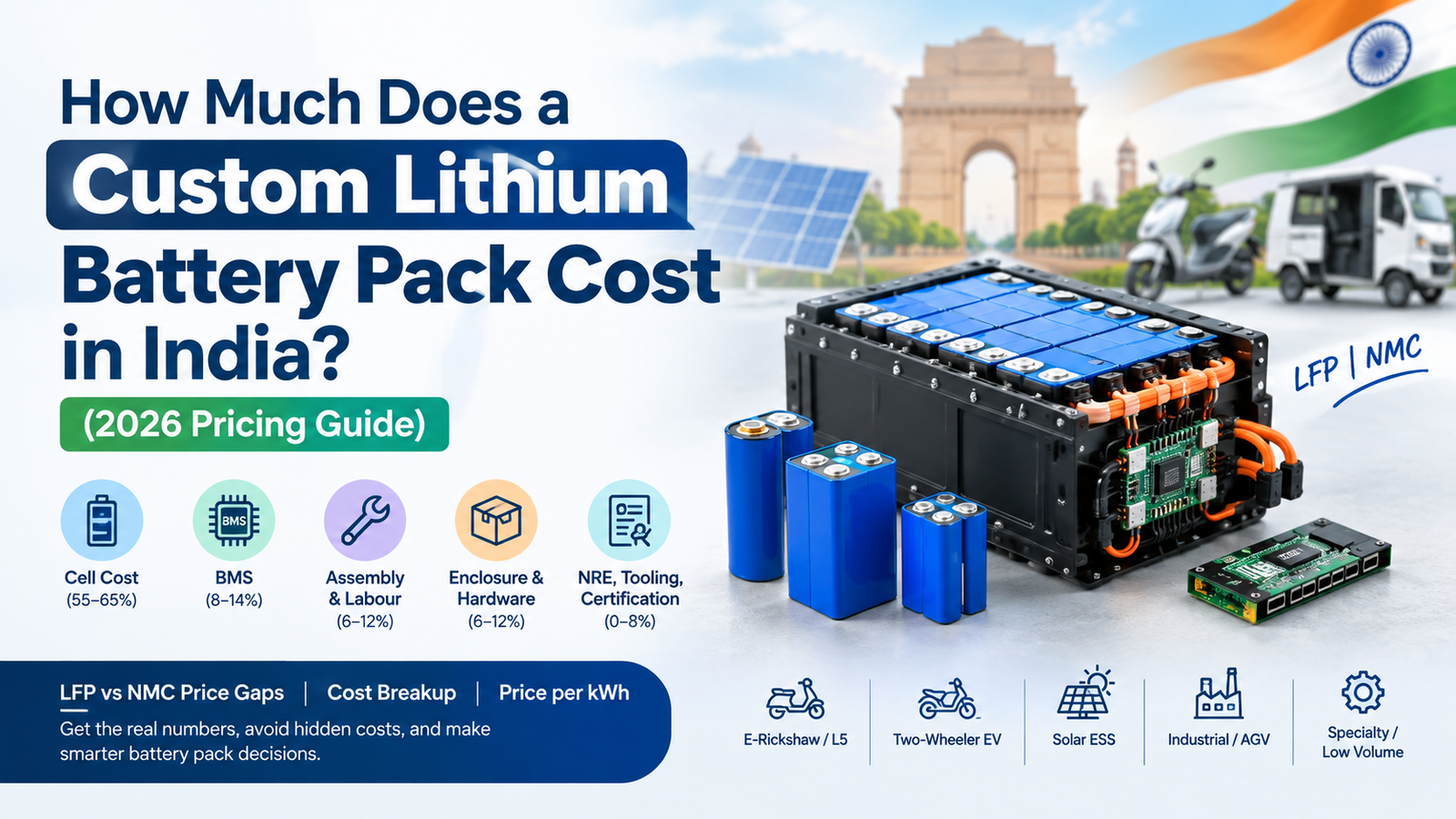
Battery pricing in India varies based on chemistry, cell brand, BMS sophistication, and order volume. Understanding the cost breakdown helps buyers negotiate intelligently and avoid suppliers who cut corners on hidden components.
The table below provides indicative pricing ranges for common pack configurations as of 2026:
| Pack Specification | Chemistry | Approximate Price Range (INR/Wh) | Typical Application |
|---|---|---|---|
| 48V 24Ah | LFP | 14–18 | E-rickshaw, light EV |
| 60V 30Ah | NMC | 18–22 | Electric scooter |
| 72V 40Ah | NMC | 19–24 | Performance two-wheeler |
| 12V 100Ah | LFP | 12–16 | Solar, inverter backup |
| 51.2V 100Ah | LFP | 15–19 | Home energy storage |
Pricing is heavily influenced by cell brand selection. A pack built with tier-1 EVE or CATL cells will naturally cost more than one assembled with grade-B or refurbished cells, but the lifespan difference more than justifies the premium.
8. The Road Ahead for Indian Battery Manufacturing
Cell-level manufacturing within India is still in its early phase, but pack-level engineering has matured considerably. Over the next three to five years, expect to see indigenous cell production come online at gigawatt scale, deeper localisation of cathode and anode material supply chains, and stronger battery recycling infrastructure. This will gradually reduce dependence on imports and bring pricing closer to global benchmarks.
For OEMs and system integrators, this means the time to build long-term supplier relationships with a capable Lithium Battery Manufacturer India is now, before capacity gets booked by larger industry players.
FAQ: Lithium Battery Manufacturer India Buyers Ask
What should I verify before hiring a lithium battery manufacturer India partner?
Check in-house or strongly controlled BMS capability, cell brand traceability, AIS-156 or IEC paperwork from accredited labs, and real thermal test evidence for Indian ambient conditions.
Is LFP always better than NMC for Indian projects?
LFP is usually safer and longer-lived in heat-heavy duty cycles. NMC still fits when energy density and weight dominate and thermal design is solid.
How long does a custom pack programme take?
Simple voltage variants can move in weeks. Full mechanical + BMS + compliance programmes often need several months from requirement freeze to production release.
Do I need UN 38.3 if packs stay domestic?
UN 38.3 is primarily a transport requirement. Many buyers still request it because logistics and export plans change; ask your shipper and compliance team.
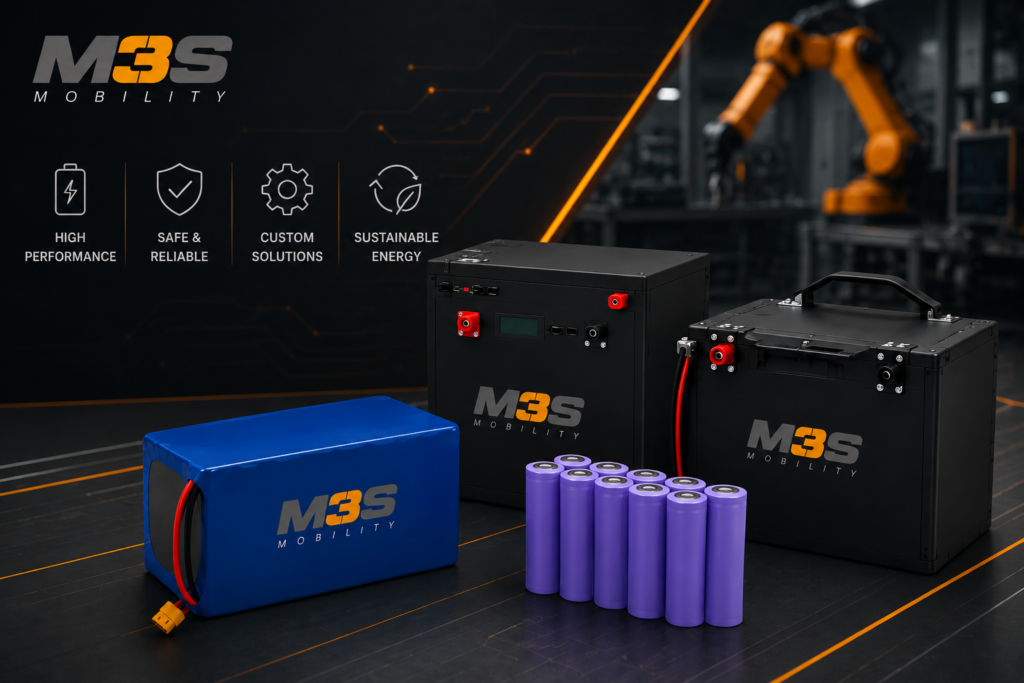
M3S Mobility has positioned itself as a trusted name in this space, offering custom-engineered lithium battery solutions for electric vehicles, energy storage, and industrial applications. Backed by in-house BMS development, rigorous quality testing, and compliance with the latest AIS-156 norms, the team works closely with OEMs and integrators to deliver packs that perform reliably under demanding Indian conditions.
Whether you need a one-off prototype or a high-volume production run, M3S Mobility brings the engineering depth and manufacturing discipline that separates a dependable supplier from the rest. Visit M3S Mobility to discuss your battery requirements and get a tailored quotation.