ev battery manufacturers
EV Battery Manufacturers, Car Battery Companies

EV Battery Manufacturers and Car Battery Companies: A Complete Beginner-Friendly Guide

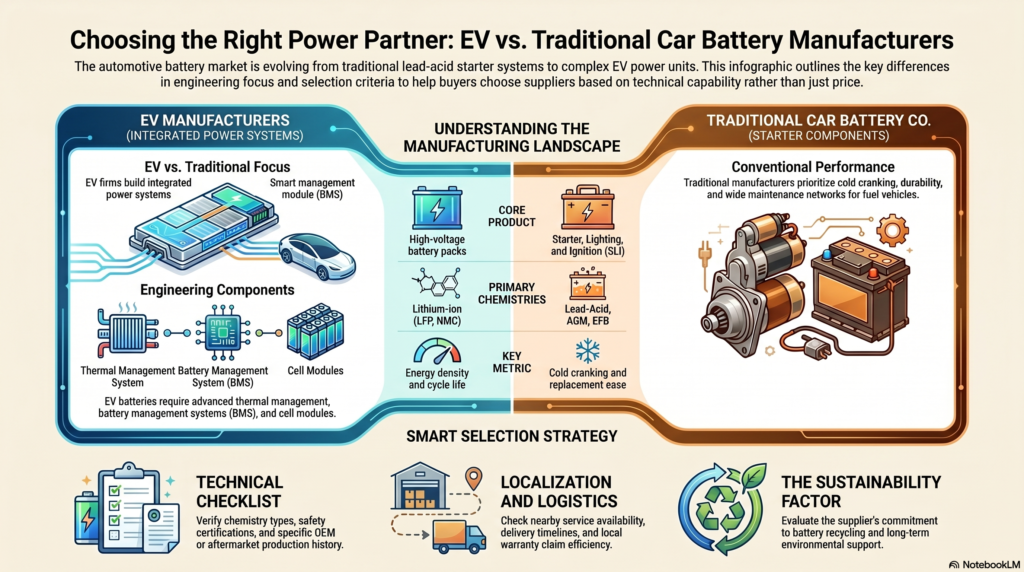
Electric mobility is growing fast, and so is the need to understand ev battery manufacturers and car battery companies. Whether you are researching suppliers, comparing brands, or simply trying to choose a reliable battery for a vehicle, the market can feel crowded at first. That is because modern batteries power everything from starter systems in fuel cars to high-voltage packs in electric vehicles, and each type needs different engineering, safety standards, and service support. For beginners, the good news is that the industry becomes easier to understand once you break it into categories. Car battery manufacturers usually focus on lead-acid, AGM, EFB, or lithium-based automotive batteries for conventional and hybrid vehicles, while ev battery companies concentrate on battery packs, cell chemistry, thermal management, and long-life performance for electric mobility. In India, this space is expanding quickly, with several companies scaling production, launching new technologies, and targeting both domestic and export demand. If you are searching online for a battery manufacturing Company near me, it helps to know what each supplier actually makes before you compare price alone. Understanding EV battery manufacturers Ev battery manufacturers design and produce battery systems for electric vehicles, usually with a strong focus on energy density, fast charging, thermal safety, and cycle life. Unlike traditional automotive batteries, EV packs often combine multiple cells, battery management systems, and cooling components into one engineered unit. The best suppliers are not just making batteries; they are building complete power systems that support range, efficiency, and vehicle safety. What they usually provide A simple example A two-wheeler EV may use a compact lithium-ion pack, while a passenger EV may need a much larger battery system with advanced cooling and software controls. That is why ev battery companies are often judged by engineering capability, not just production volume. Car battery companies in focus Car battery companies serve a broader market that includes petrol cars, diesel cars, hybrids, commercial vehicles, and aftermarket replacement batteries. Many of these firms are established auto battery manufacturers with a strong history in lead-acid technology, though more are now adding lithium-ion and start-stop solutions. Well-known global players include Clarios and Exide Technologies, while India has strong brands such as Exide, Amara Raja, and Eastman. What matters most in this segment For everyday car owners, these factors often matter more than flashy technology claims. A dependable battery that starts well in heat, traffic, and short-trip use is usually the smartest choice. Auto battery manufacturers to compare When comparing auto battery manufacturers, it helps to separate the discussion into conventional automotive batteries and EV-related batteries. Conventional batteries still dominate many vehicle categories, especially in replacement markets and internal combustion cars. At the same time, EV battery production is expanding sharply, especially in Asia-Pacific and India. Good comparison points A useful mini case study is India, where battery makers are investing in new plants, R&D hubs, and lithium-ion capabilities to support growing EV demand. This shows how auto battery manufacturers are evolving from traditional replacement suppliers into technology-driven energy companies. Choosing the right supplier If you are evaluating car battery manufacturers or ev battery manufacturers, start with your actual use case. The best supplier for a fleet operator may be very different from the best supplier for an EV startup or a local retail buyer. For example, a company selling high-volume starter batteries may not be the best fit for advanced EV pack development. Smart selection checklist If you are searching for a Battery manufacturing Company near me, also check local service availability, installation support, and whether the company handles warranty claims efficiently. A nearby supplier is useful, but a reliable one is better. Trends shaping the market The battery industry is being shaped by three major trends: electrification, localization, and sustainability. In India, the EV battery market is projected to grow strongly through the next decade, driven by policy support, charging expansion, and rising EV adoption. Globally, the automotive battery market is also expanding as EVs and hybrids become more common. What this means for buyers For businesses, this means supplier selection is becoming more strategic. Ev battery companies are increasingly expected to deliver not just batteries, but integrated energy solutions with long-term value. Real-world buying tips Before you finalize any supplier, think beyond the brand name. The strongest car battery companies usually combine product quality, technical service, and consistent availability. The same applies to EV suppliers, where pack design, chemistry, and lifecycle performance can determine total cost of ownership. Practical tips This approach helps both consumers and businesses avoid low-quality purchases. It also reduces downtime, which matters for fleet operators and everyday drivers alike. Final Words The battery market is bigger and more diverse than many beginners expect. Ev battery manufacturers are driving electric mobility forward, while car battery companies and auto battery manufacturers continue to support the huge conventional vehicle market. If you compare chemistry, service, warranty, and manufacturing capability instead of price alone, you can choose a battery partner that performs well and lasts longer. For businesses, this industry is moving toward smarter, safer, and more localized production. For buyers, that means better choices today and stronger battery technology tomorrow.