Custom Battery Pack Manufacturer

Custom Battery Pack Manufacturer

Custom Battery Pack Manufacturer | Lithium-ion Solutions

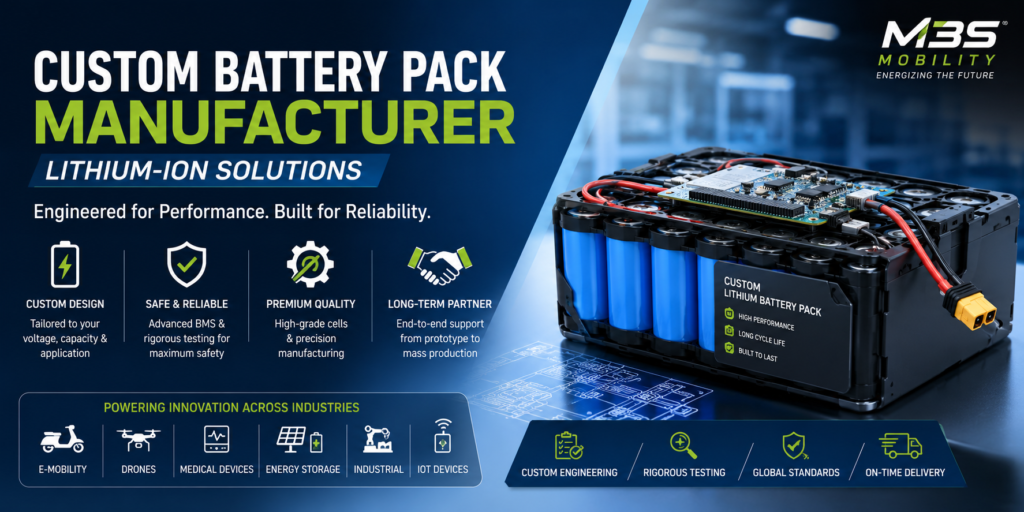
Choosing the right Custom Battery Pack Manufacturer quietly shapes everything downstream in your product. Runtime, safety, field performance, whether the device passes certification the first time — it all traces back to the pack inside. And here’s what most product teams learn the hard way: an off-the-shelf cell rarely fits a real-world application cleanly. That gap is exactly where M3S Mobility works. As a dedicated Custom Battery Pack Manufacturer, we design, engineer, and build lithium-ion energy solutions tuned to the precise voltage, capacity, form factor, and safety profile your product demands. This guide covers what a serious battery partner actually does, how a custom lithium battery pack is designed from the ground up, why Battery Management Systems matter more than most buyers realise, which chemistries fit which jobs, and how to choose a supplier that ships reliable packs on schedule. Let’s get into it. Why the Right Battery Partner Beats Off-the-Shelf Off-the-shelf batteries are built for the average. Your product isn’t average. A drone needs a high discharge rate in a tight weight envelope. A medical device needs certified safety and predictable cycle life. An electric vehicle needs thermal stability across brutal duty cycles. One generic pack cannot serve all three — and forcing it to try is how you end up with overheating, early failures, and returns piling up. A capable supplier starts from your requirements, not from a catalogue. At M3S Mobility, we ask about your device’s peak and continuous current draw, its operating temperature range, the physical space you have to work with, the runtime your users expect, and the regulatory standards you’re chasing. From those inputs, we engineer a custom lithium battery pack that fits — literally and electrically. Worth noting: the difference shows up in the numbers. India’s lithium-ion battery market has been growing rapidly, driven by electric mobility, renewable storage, and consumer electronics. The country’s push toward EV adoption and domestic manufacturing under national incentive schemes has made local, tailored battery pack design more valuable than ever. Buyers who once imported generic packs now want a partner who can iterate fast, hold quality, and support them for the long haul. Honestly, most businesses underestimate how much a well-matched pack saves. Fewer warranty claims. Longer product life. Better user reviews. The pack stops being a liability and starts being a competitive edge. A generic cell that’s “close enough” bleeds money slowly — through returns, through reputation, through the engineering hours you burn troubleshooting a problem you could have designed out at the start. Think about it from your customer’s side. They don’t see the cell. They see whether the device lasts a full shift, whether it charges predictably, whether it ever gets warm in a way that worries them. Every one of those impressions is set by decisions made during battery pack design. Get those decisions right and the product feels solid. Get them wrong and no amount of marketing fixes it. What Makes M3S Mobility a Trusted Custom Battery Pack Manufacturer We’re not a reseller sticking a label on someone else’s cells. M3S Mobility is a hands-on custom battery pack manufacturer that controls the process end to end — from cell selection and battery pack design through assembly, Battery Management Systems integration, testing, and delivery. That vertical control is the whole point. When one team owns the pack from brief to shipment, accountability never gets lost in a handoff. Precision Engineering Every custom lithium battery starts on the engineering bench. We model the pack for performance and safety before a single cell is welded. That means calculating thermal behaviour, mapping current paths, and validating the mechanical layout so the pack survives vibration, shock, and daily handling. Precision here isn’t perfectionism for its own sake — it’s what keeps a pack safe and consistent across thousands of units. Application-Specific Design We build for what your product actually does. E-bikes, EVs, drones, energy storage systems, medical equipment, IoT devices, industrial tools — each gets a battery pack design shaped around its real duty cycle, not a generic template. A pack for a delivery drone that cycles hard every day looks nothing like a pack for a backup power unit that sits idle then discharges slowly. Treating them the same is a mistake we don’t make. Quality You Can Audit Reliability isn’t a slogan here. It’s a process. Each custom lithium battery pack passes through staged quality control — incoming cell inspection, in-process checks, and final validation — so what leaves our facility performs the way the spec promised. If a unit doesn’t meet the mark, it doesn’t ship. That’s the standard, and it’s why clients trust us with products where failure isn’t an option. Long-Term Partnership The best supplier relationships last years, not one purchase order. We support revisions, scale production as your volumes grow, and stay reachable when you need answers. That continuity is a big part of why clients keep coming back — the pack you launch with is rarely the last pack you’ll need, and having the same engineering team through every iteration saves enormous time. The Custom Lithium Battery Pack Design Process, Step by Step People often picture battery manufacturing as bolting cells together. The reality is more deliberate. Here’s how a proper custom lithium battery pack comes to life at M3S Mobility, stage by stage. 1. Requirement Analysis We begin with a conversation, not a quote. What’s the application? What voltage and capacity does it need? What’s the discharge profile — a steady draw, or sharp peaks? How much space is available, and what shape? Which certifications matter? This phase is where a good battery partner earns its keep, because getting the brief right prevents expensive rework later. A misread requirement at this stage multiplies into problems everywhere downstream, so we slow down and get it precise. We also probe the edge cases that buyers forget to mention. What’s the coldest environment the device will see? The hottest? Will it charge from a wall adapter, a solar input, a vehicle

Lithium Battery Manufacturer India
EV Battery Manufacturers, Custom Battery Pack Manufacturer, Lithium Battery Manufacturer India, Lithium Ion Battery Pack Supplier

Lithium Battery Manufacturer India | Custom Battery Pack Supplier

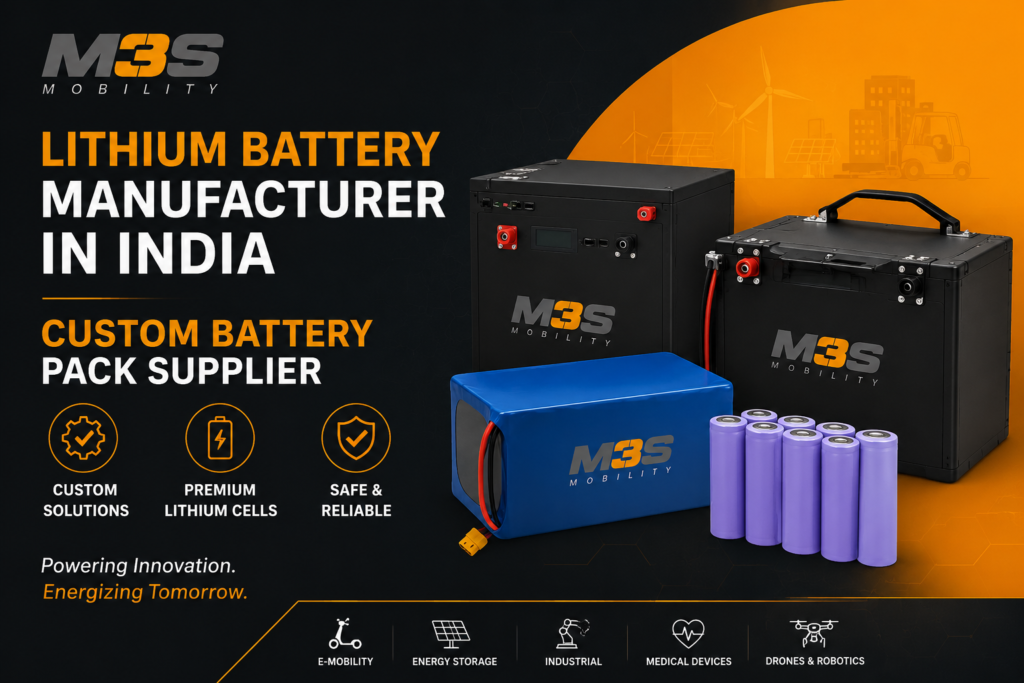
The shift from fossil fuels to clean energy storage has turned Lithium Battery Manufacturer India into one of the most strategically important industries of the decade. Walk into any electric two-wheeler showroom, solar installation site, or telecom tower facility across India, and you’ll find lithium-ion cells quietly powering the entire operation. What was once an imported commodity is now being designed, assembled, and customised on Indian soil, and the businesses driving this change are reshaping how mobility, energy, and industrial automation work in the country. Choosing the right battery partner is no longer just a procurement decision. It directly affects product safety, warranty claims, runtime performance, and the long-term economics of any electric or stored-energy application. This guide breaks down what every buyer, OEM, and project manager should know before signing a purchase order with a Lithium Battery Manufacturer India , Lithium Ion Battery Pack Supplier, Custom Battery Pack Manufacturer. 1. Why India Is Becoming a Global Battery Manufacturing Hub India’s push toward localised battery production is not accidental. Government incentives under the PLI scheme, FAME-II subsidies for electric vehicles, and a domestic EV market growing in double digits every quarter have created the perfect environment for cell assembly and pack engineering to scale. Add to that a deep talent pool of electrical and mechanical engineers, and the country now offers a manufacturing proposition that competes seriously with East Asian suppliers. Domestic players are no longer just assembling imported cells. Many have invested in BMS design, thermal management research, and mechanical pack engineering tailored to Indian temperature extremes and load patterns. This vertical integration is what separates a hobbyist assembler from a serious industrial supplier. 2. Applications Driving Custom Battery Pack Demand A standardised battery rarely fits every real-world use case. Voltage ranges, form factors, and ingress protection requirements vary dramatically from one application to another. This is exactly why working with a proper Custom Battery Pack Manufacturer matters more than buying off-the-shelf packs. Common applications where custom packs are essential include: Each of these has unique thermal, vibration, and cycle-life requirements that cannot be addressed by a generic product line. 3. What to Look for in a Lithium Battery Manufacturer India Selecting a manufacturer goes well beyond comparing per-kWh pricing. The technical depth, in-house testing infrastructure, and after-sales support of a Lithium Battery Manufacturer India determine whether your product will perform reliably for years or fail within months. Key evaluation criteria include: 4. Understanding Battery Chemistry Options Not all lithium chemistries are interchangeable. A pack designed for a high-performance electric scooter behaves very differently from one built for a stationary solar bank. The chemistry you select dictates safety, lifespan, energy density, and cost. Most Indian buyers will encounter two dominant chemistries, and understanding their trade-offs is critical before placing an order. The table below summarises the practical differences between the most widely used cell types in the Indian market: Chemistry Energy Density (Wh/kg) Cycle Life Thermal Stability Typical Use Case LFP (LiFePO4) 90–120 3000–6000 Excellent E-rickshaws, solar storage, telecom NMC (LiNiMnCoO2) 150–220 1000–2000 Moderate Two-wheelers, performance EVs, drones LTO (Li4Ti5O12) 60–80 10000+ Outstanding Heavy industrial, fast-charging fleets LCO (LiCoO2) 150–200 500–1000 Low Consumer electronics only LFP has emerged as the workhorse for Indian conditions because of its superior thermal stability and longer cycle life, both of which are critical given the temperature stress local applications face. 5. The Custom Pack Manufacturing Process A properly engineered battery pack passes through several disciplined stages, and skipping any one of them creates field failure risk. A reputable Lithium Battery Manufacturer India, Lithium Ion Battery Pack Supplier follows a structured workflow from concept to dispatch. The process typically includes: 6. Certifications and Compliance That Matter Battery safety has become a regulatory priority following the EV fire incidents reported across India in recent years. Government bodies have tightened compliance norms significantly, and any serious supplier must demonstrate full conformity. Mandatory and recommended certifications include: Buyers should always request test reports issued by NABL-accredited labs rather than internal certificates of conformity. 7. Cost Structure and Pricing Transparency Battery pricing in India varies based on chemistry, cell brand, BMS sophistication, and order volume. Understanding the cost breakdown helps buyers negotiate intelligently and avoid suppliers who cut corners on hidden components. The table below provides indicative pricing ranges for common pack configurations as of 2026: Pack Specification Chemistry Approximate Price Range (INR/Wh) Typical Application 48V 24Ah LFP 14–18 E-rickshaw, light EV 60V 30Ah NMC 18–22 Electric scooter 72V 40Ah NMC 19–24 Performance two-wheeler 12V 100Ah LFP 12–16 Solar, inverter backup 51.2V 100Ah LFP 15–19 Home energy storage Pricing is heavily influenced by cell brand selection. A pack built with tier-1 EVE or CATL cells will naturally cost more than one assembled with grade-B or refurbished cells, but the lifespan difference more than justifies the premium. 8. The Road Ahead for Indian Battery Manufacturing Cell-level manufacturing within India is still in its early phase, but pack-level engineering has matured considerably. Over the next three to five years, expect to see indigenous cell production come online at gigawatt scale, deeper localisation of cathode and anode material supply chains, and stronger battery recycling infrastructure. This will gradually reduce dependence on imports and bring pricing closer to global benchmarks. For OEMs and system integrators, this means the time to build long-term supplier relationships with a capable Lithium Battery Manufacturer India is now, before capacity gets booked by larger industry players. M3S Mobility has positioned itself as a trusted name in this space, offering custom-engineered lithium battery solutions for electric vehicles, energy storage, and industrial applications. Backed by in-house BMS development, rigorous quality testing, and compliance with the latest AIS-156 norms, the team works closely with OEMs and integrators to deliver packs that perform reliably under demanding Indian conditions. Whether you need a one-off prototype or a high-volume production run, M3S Mobility brings the engineering depth and manufacturing discipline that separates a dependable supplier from the rest. Visit M3S Mobility to discuss your battery requirements and get a tailored quotation.

Scroll to Top