If you’re an EV OEM, solar EPC, or industrial product team in India, custom battery pack design is usually the first real bottleneck—not cell price. Specs get sketched on a slide, then a supplier quotes a number that ignores enclosure tooling, AIS-156 samples, or the BMS you actually need for Delhi NCR summer heat.
This piece walks through a practical battery pack design process, what drives custom battery pack cost, and how battery pack prototyping India programs typically run—so you can budget months and rupees before you sign a PO. You’ll get timelines, cost tables, a DFM checklist, and the mistakes that quietly inflate NRE.
What Is Custom Battery Pack Design?
Custom battery pack design means engineering a lithium-ion pack around your voltage, capacity, form factor, duty cycle, and compliance path—not dropping a catalogue SKU into a chassis that almost fits.
It covers cell selection, series-parallel architecture, BMS design, thermal management, enclosure and IP rating, connectors, harnessing, and DFM so the pack can be built at volume. Done well, custom battery pack design also locks test plans for BIS, AIS-156, or UN38.3 early—before prototypes freeze the wrong geometry.
Here’s the thing: off-the-shelf packs win on speed. Custom wins when weight, mounting, communication protocol, or certification scope doesn’t match anything on a distributor list.
Why Most Design Quotes Miss Reality
Many RFQs ask only for “48V 50Ah LFP.” That’s not a design brief. Without C-rate, ambient, vibration class, and communication (CAN, RS485, UART), suppliers guess—and custom battery pack costs balloon in revision two.
Honestly, the gap between a napkin sketch and a certifiable pack is where programs die. A clear battery pack design process forces those decisions in week one, not week twelve.
PLI-backed cell supply and FAME-II-driven EV volumes have improved India’s options, but they haven’t removed the need for application-specific custom battery pack design. Tier-2 assemblers still skip thermal modelling and call it “design.”
The Battery Pack Design Process (Step by Step)
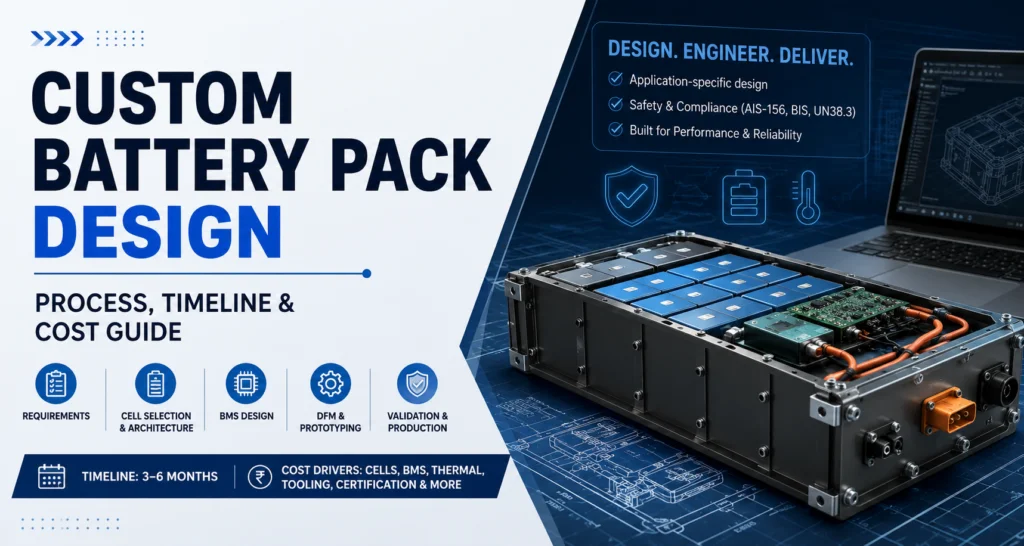
A repeatable battery pack design process keeps engineering, compliance, and purchasing aligned. Use this sequence whether you work with a Delhi NCR pack house or a Pune cell line.
1. Requirements freeze
Capture voltage window, Ah/kWh, peak and continuous current, charge profile, ambient (−10°C to 55°C is common for India road use), mounting, weight limit, and target IP rating. Note the vehicle category if AIS-156 applies.
2. Cell selection and architecture
Cell selection picks chemistry (LFP vs. NMC), format (18650, 21700, prismatic), and grade. Then you set a series-parallel count so the pack meets energy and power without cooking the weakest cell. This step dominates both safety and custom battery pack cost.
3. BMS design and firmware
BMS design sets protection limits, balancing strategy, SOC algorithm, and bus protocol. For e-rickshaw and L5 fleets, CAN is increasingly expected. Cheap BMS boards without logging make field failures untraceable.
4. Mechanical, thermal, and enclosure
CAD covers cell fixtures, busbars, compression, vents, and connectors. Thermal management may be passive (TIM, heat spreaders) or active for high C-rate packs. Enclosure choice locks IP rating and tooling spend.
5. DFM and prototype build
DFM reviews weld access, harness routing, fastener torque, and serviceability. Then battery pack prototyping India builds A/B samples for electrical and abuse screening. Sample lead time depends on cell stock and mould complexity.
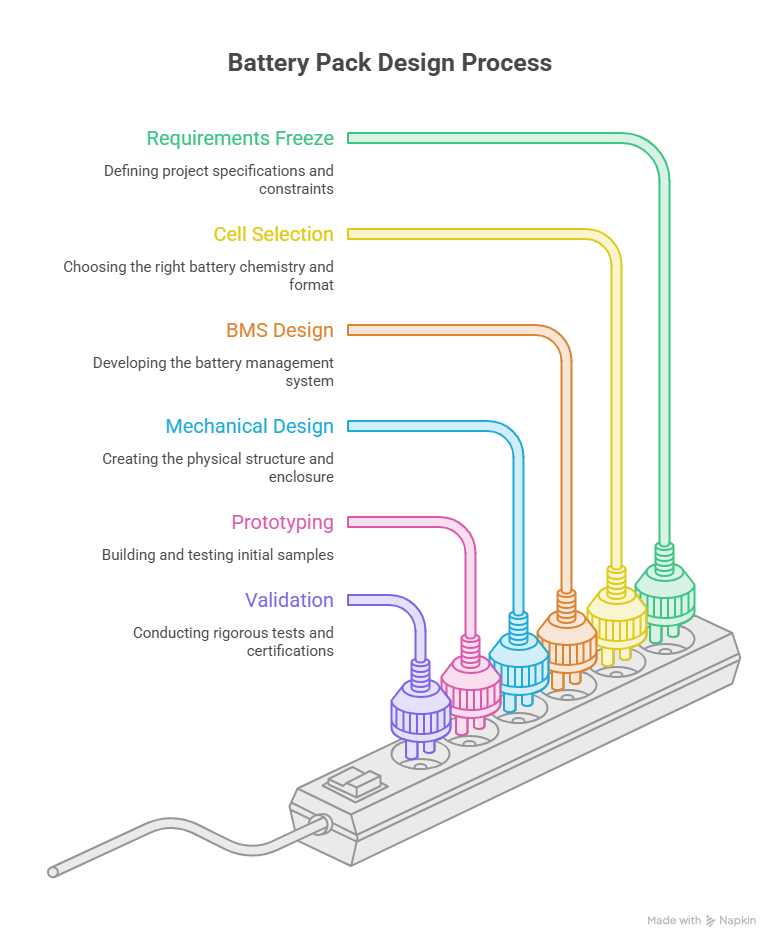
6. Validation, iterate, release to production
Lab tests, firmware tweaks, and enclosure fixes close the loop. Only then does custom battery pack design hand off to manufacturing SOPs, IQC, and EOL fixtures.
| Stage | Typical duration | Main outputs |
| Requirements & architecture | 1–2 weeks | Spec sheet, S-P map, risk list |
| Schematic / BMS / thermal concept | 2–4 weeks | BMS BOM, thermal sketch, connector list |
| Mechanical CAD + DFM | 3–6 weeks | 3D models, drawing pack, DFM notes |
| Prototype build (A sample) | 2–5 weeks | Working packs, basic test log |
| Validation & B/C samples | 4–10 weeks | Certification samples, firmware freeze |
| Production release | 2–4 weeks | SOP, fixtures, first article |
That’s a realistic battery pack design process window of roughly 3–6 months for a mid-complexity EV or industrial pack—shorter if cells are stocked and the enclosure is sheet metal, longer if you need AIS-156 plus custom molds.
Custom Battery Pack Cost: What Actually Moves the Number
Buyers ask for one line-item price. Suppliers think in NRE + units. Separating those is the only way to compare quotes for custom battery pack design.
| Cost driver | What it covers | How it scales |
| Cells | Chemistry, grade, brand, freight | Dominant share of unit cost |
| BMS & electronics | Board, sensors, firmware, CAN | Mid rises with smart features. |
| Mechanical & enclosure | Sheet metal, molded case, gaskets | High NRE if moulded |
| Assembly & test | Weld, harness, EOL, aging | Falls with volume |
| Certification samples | AIS-156, BIS, UN38.3 packs | Fixed program cost |
| Tooling / fixtures | Weld jigs, EOL fixtures | Amortized over volume |
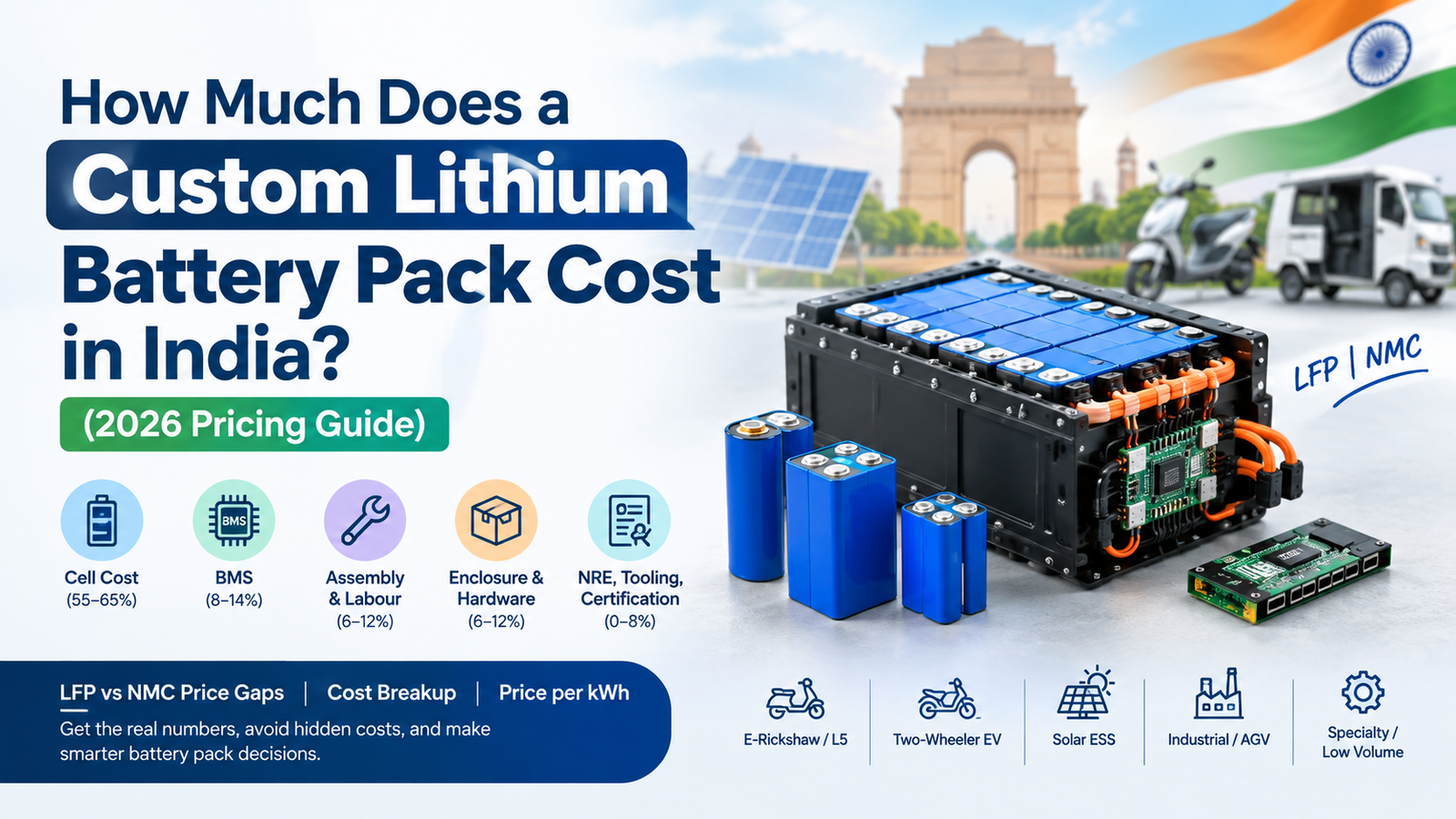
The custom battery pack cost for a simple 48V industrial pack can look very different from a sealed traction pack with liquid cooling and dual CAN. Don’t benchmark ₹/kWh alone when the duty cycle isn’t the same.
Cells still dominate unit economics. LFP often wins for cycle life and thermal calm in India; NMC wins when volume or weight is the constraint. That cell selection choice can make a custom battery pack cost more than any enclosure tweak.
NRE commonly includes CAD hours, BMS firmware, fixture design, and first-article validation. Ask for that split in writing. If a quote bundles everything into “per pack,” you’ll never know whether you’re paying for engineering or inventory risk.
Battery Pack Prototyping India: Lead Times and Expectations
Battery pack prototyping in India has matured. Delhi NCR, Noida, Pune, and Bengaluru shops can turn A-samples faster than five years ago—if cells are available and your brief is frozen.
Typical sample lead time for a non-moulded pack: 2–5 weeks after cell receipt. Moulded enclosures add tooling weeks. Certification samples for AIS-156 need extra units and a documented build record.
When you evaluate battery pack prototyping India partners, ask:
- Do they keep weld and BMS flash logs per serial?
- Can they change one parameter (balancing current, UVP) without a full redesign?
- What’s the plan if the first cell selection lot fails IR matching?
That’s the difference between a prototype that teaches you something and a pretty brick that fails at ARAI.
Strong battery pack prototyping in India programmes also plan B-samples for vibration and thermal soak before you freeze marketing range claims. Skipping that step to “save a month” is how fleets discover swell in month four.
LSI Deep Dive: Thermal, IP Rating, and DFM
Thermal management isn’t optional in India. Packs sitting in e-rickshaw trays under 45°C ambient need sensor placement at hot spots, not only at the BMS board. Passive designs work for modest C-rates; high-power automation packs may need forced air or liquid loops.
IP rating choices (IP54 vs. IP65/67) change gasket design, connector family, and cost. Over-specifying IP67 for a sheltered UPS cabinet wastes money. Under-specifying IP for under-chassis EV mounts invites water ingress claims.
DFM is where custom battery pack design either scales or dies. If operators can’t reach a weld joint, yield collapses. If the BMS connector sits under a sealed lid with no service hatch, field swaps become scrap events.
Keep BMS design and mechanical design in the same review meeting. Electrical teams love dense layouts; production teams need clearance. A joint battery pack design process gate prevents that fight from happening on the line.
Buyer Checklist Before You Approve Design
Use this before you green-light custom battery pack design spend:
- Is the duty cycle written (peaks, RMS, regen)?
- Has cell selection been justified against chemistry alternatives?
- Does BMS design match your charger and vehicle ECU protocol?
- Are thermal management and sensor maps documented?
- Is the target IP rating signed by both the mechanical and application owners?
- Has a DFM review logged open issues with owners and dates?
- What’s the sample lead time for A and B units, cell stock risk included?
- Who owns certification sample builds and lab booking?
- How is custom battery pack cost split between NRE and unit price at 100 / 500 / 2,000 pcs?
- Does the partner’s battery pack prototyping India flow include EOL data you can keep?
If three or more answers are “we’ll figure it out later,” pause the PO.
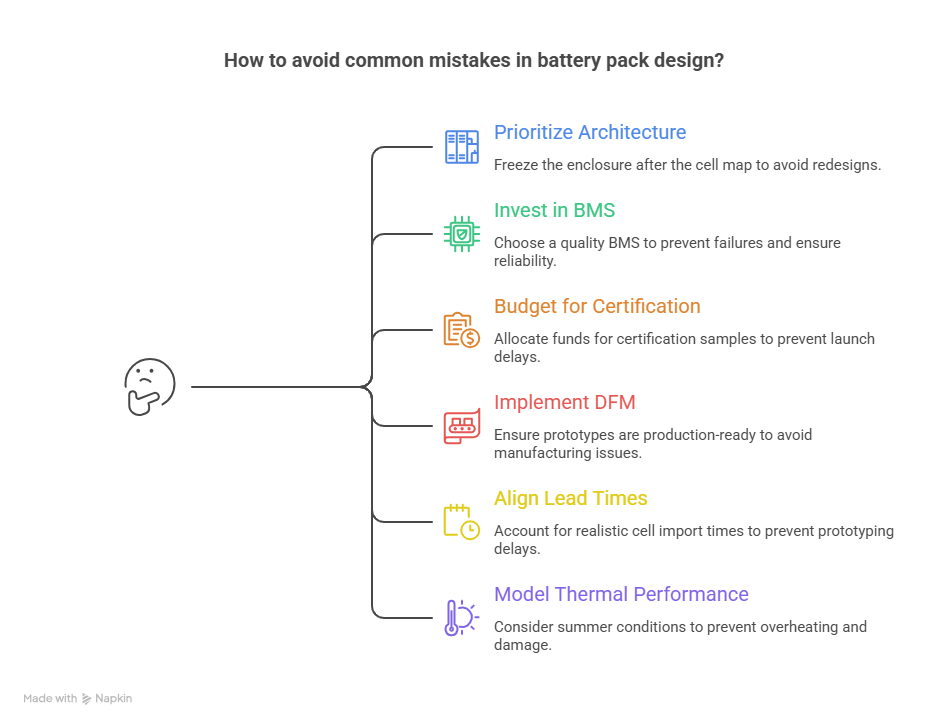
Common Mistakes That Inflate Timeline and Cost
Freezing the enclosure before the cell map. Pretty CAD with the wrong S-P count forces a redesign. Put architecture ahead of styling in every battery pack design process.
Treating BMS as a commodity. A ₹400 board may look fine until balancing fails at cycle 200. BMS design quality is insurance, not a place to shave pennies after cell selection.
Ignoring certification sample volume. AIS-156 and abuse tests consume packs. Budget them inside the custom battery pack cost, or your launch date slips when the lab asks for three more units.
Skipping DFM. Hand-built prototypes that can’t be welded at a rate are not production-ready. DFM gates belong before you celebrate the first light-up.
Optimistic sample lead time. If cells are on a 10-week import, your battery pack prototyping India calendar isn’t a 3-week story. Align purchasing early.
No thermal model for summer. Delhi NCR and Rajasthan duty cycles punish packs designed for brochure ambient. Thermal management assumptions belong in the requirements freeze.
Each of these mistakes turns a clean custom battery pack design into a revision spiral. Catch them in the checklist, not in a fleet callback.
Documentation You Should Demand Mid-Design
Good custom battery pack design leaves a paper trail. Before you approve tooling, ask for:
- Updated electrical architecture (S-P map, fuse strategy)
- BMS parameter sheet with OVP/UVP/OCP/OTP values
- Thermal sensor map tied to the enclosure CAD
- Connector pinouts and mating part numbers
- Risk register covering cell supply, mould delay, and lab booking
These artifacts make the design program auditable when team members change mid-stream. They also clarify change orders—if the brief didn’t move, NRE shouldn’t mysteriously double.
For EV-adjacent work, keep a parallel compliance matrix: which tests are internal, which need ARAI or other accredited labs, and how many packs each consumes. That matrix belongs beside the Gantt, not in someone’s inbox.
Volume Breaks and Cost Curves
Early custom battery pack design quotes often assume 100–500 units. At 2,000+ units, fixture amortization and cell contracts change the story. Ask for price points at three volumes so finance can model ramps at matched scales.
Don’t chase the lowest cell quote if grade or IR spread is worse. A 3% cell saving that wrecks yield is not a saving. Mature prototyping partners will show you matching histograms from the lot they’ll actually build—not a marketing COA from a different batch.
How M3S Approaches Design Programmes
M3S Mobility, based in the Noida/Delhi NCR corridor, runs custom battery pack design for B2B OEMs who need application-fit packs rather than catalogue SKUs. The team ties cell selection, BMS design, and enclosure DFM into one program so custom battery pack cost and sample lead time stay visible.
If you’re comparing prototyping partners, ask for a stage-gate plan that looks like the table above—not a one-line delivery promise. Soft CTA: share your voltage, capacity, and duty cycle, and request a design-scope quote from M3S Mobility when you’re ready to move past spreadsheet guesses.
Final Words
Custom battery pack design succeeds when requirements are sharp, the battery pack design process is staged, and custom battery pack cost is split into NRE versus unit economics. Pair that with realistic battery pack prototyping India timelines, and you avoid the classic India OEM trap: a beautiful first sample that can’t certify or scale.
Treat cell selection, BMS design, thermal management, IP rating, and DFM as first-class decisions inside every custom battery pack design review. Then build. If you want a second set of eyes on a brief, M3S Mobility can review the scope and propose a staged path from concept to production release—grounded engineering with a clear battery pack design process you can defend to your board. Strong custom battery pack design is boring on paper and reliable in the field.
FAQs
How long does custom battery pack design take in India?
Most mid-complexity custom battery pack design programmes need 3–6 months from frozen requirements to production release. Simple sheet-metal packs with stocked cells can move faster; AIS-156 plus custom moulds take longer.
What drives custom battery pack cost the most?
Cells dominate unit price. Enclosure tooling, BMS sophistication, certification samples, and low volumes drive NRE and early-unit pricing.
What is a realistic sample lead time for prototypes?
For non-moulded packs with cells in hand, sample lead time is often 2–5 weeks. Moulded cases and scarce cell lots extend that window.
Do I need AIS-156 for every custom pack?
No. AIS-156 applies mainly to EV traction packs under Automotive Industry Standards. Stationary UPS or industrial packs follow different BIS / application rules — confirm early in the battery pack design process.
Why does DFM matter if my prototype already works?
A hand-built prototype can hide weld access and harness issues. DFM ensures the same pack can be built repeatedly at volume without scrap spikes.
Can M3S Mobility support battery pack prototyping India programmes?
Yes. M3S supports battery pack prototyping India builds alongside full custom battery pack design, including BMS configuration and production handoff for B2B OEMs.