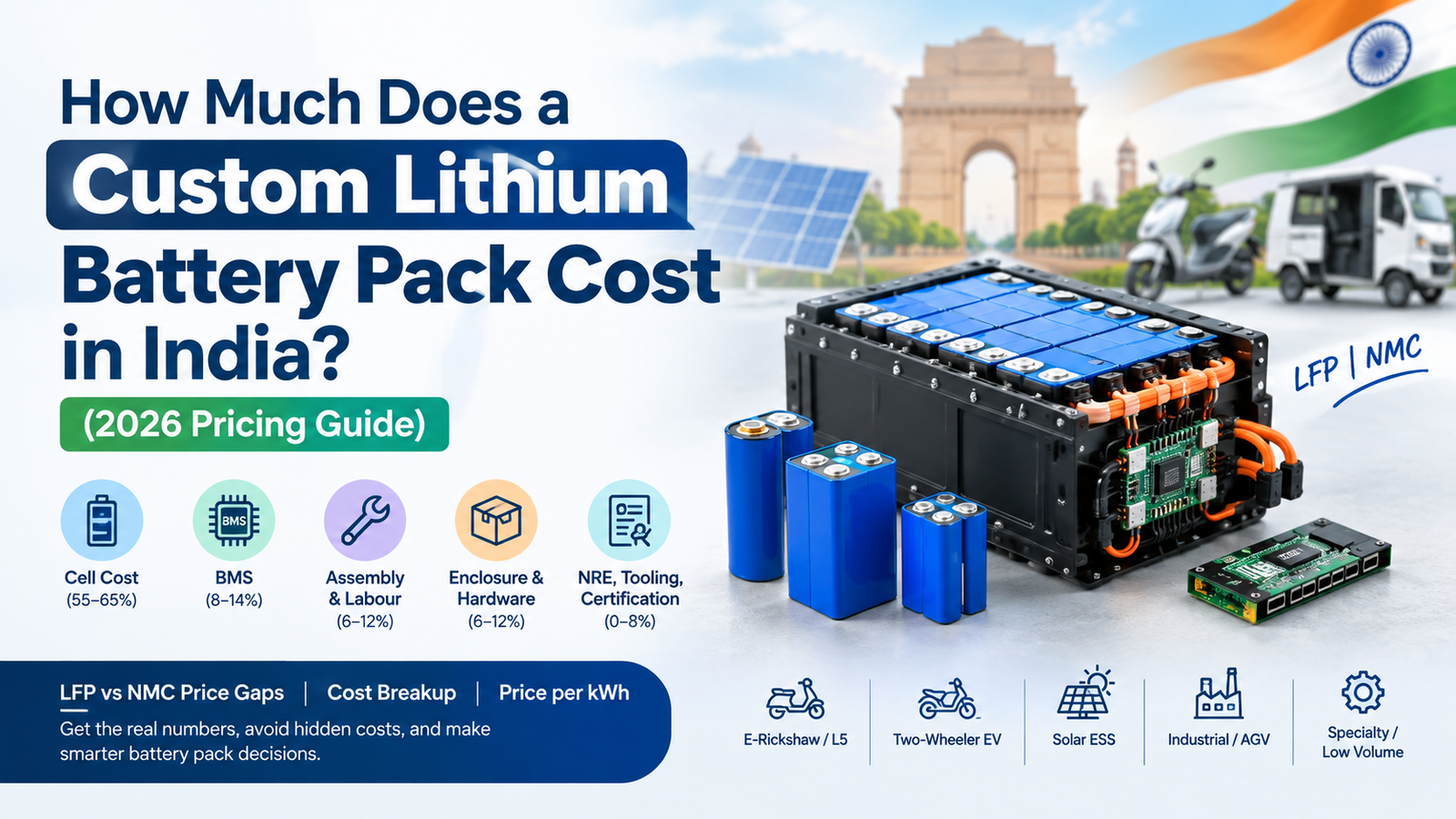
The future of battery technology is no longer a distant R&D slideshow. In India, it shows up in which chemistry you specify for a 2026 scooter launch, how you price a solar ESS bank, and whether your supply chain still depends on imported cells.
This article maps the practical future of battery technology trends that matter for OEMs, EPCs, and fleet buyers  solid-state, sodium-ion, LFP scale-up, PLI gigafactories, recycling, and smarter BMS software  without the “delves into†fluff. For foundational context, see Lithium-ion battery on Wikipedia.
Why the Future of Battery Technology Matters in India Now
EV two-wheelers, e-rickshaws, telecom backup, and distributed solar storage are all scaling at once. Pack cost, safety, and cycle life decide product margins more than branding ever will.
India still imports a large share of cells, but pack-level engineering and policy (FAME-linked demand, ACC PLI capacity) are moving fast. The buyers who understand the future of battery technology avoid locking into obsolete chemistries or fragile import-only SKUs.
Lithium-Ion Remains the Bridge Chemistry
Li-ion is still the commercial baseline  strong energy density, mature manufacturing, and a deep supplier ecosystem. Limitations remain: material cost volatility, thermal runaway risk if BMS and cell quality slip, and import dependence for many formats.
That is why LFP is winning so many Indian duty cycles while NMC stays in premium, weight-sensitive platforms. A modern lithium battery manufacturer India partner will push you toward chemistry that matches heat, cycle life, and warranty  not just the highest Wh/kg on a slide.
Solid-State Batteries: Important, Not Immediate
Solid-state cells replace liquid electrolyte with a solid conductor. The pitch is higher energy density, faster charge, and better thermal behaviour. Global programmes at OEMs and cell makers are real; Indian commercial timelines for mainstream EVs still point toward 2030+ for volume.
- Watch for pilot packs and aerospace / premium niches first
- Do not redesign a 2026–2028 mass product around solid-state availability
- Keep mechanical and BMS architectures flexible for later cell drops
Solid-state is part of the future of battery technology story  treat it as a roadmap item, not a purchase order for next quarter.
Sodium-Ion: The Cost Disruptor to Watch
Sodium-ion uses abundant raw materials and can undercut lithium on cost for applications where energy density is secondary. Early commercial products globally target stationary storage and cost-sensitive mobility; Indian R&D and industrial pilots are accelerating under localisation pressure.
- Best near-term fit: ESS, telecom backup, some L5 / cost-sensitive fleets
- Energy density still trails premium NMC
- Track pilot pricing through 2027–2029 before hard commitments
LFP Dominance Through the Late 2020s
While solid-state and sodium-ion grab headlines, LFP is the chemistry doing the most commercial work in India right now. Thermal stability, long cycle life, and falling cell prices make it the default for e-rickshaws, solar ESS, and many industrial packs.
If your product lives outdoors in Indian heat, LFP should be the first serious option on the table  with NMC reserved for range-critical designs that can afford stronger thermal management.
PLI, Gigafactories, and Local Supply Chains
The ACC PLI programme is meant to pull cell manufacturing onshore at multi-GWh scale. As gigafactory capacity commissions through the late 2020s, buyers should see shorter lead times, more local formats, and gradually less FX exposure on cells.
Until then, pack assemblers with strong cell sourcing, incoming QA, and BMS capability remain the practical bottleneck. That is the day-to-day reality inside battery pack manufacturing lines across Delhi NCR and other hubs.
Recycling, Second Life, and EPR Pressure
As pack volumes grow, recycling and second-life reuse stop being CSR slides. Extended Producer Responsibility rules, rising scrap volumes, and stationary second-life projects all reshape total cost of ownership.
- Design for disassembly and cell traceability from day one
- Ask suppliers how they handle end-of-life and warranty returns
- Evaluate second-life ESS only with clear remaining-capacity grading
Circular economics is a core pillar of the future of battery technology, not a footnote.
AI, Smart BMS, and Connected Packs
Software is changing how packs age in the field. Cloud-linked BMS platforms, predictive degradation models, and OTA firmware updates turn a pack into a managed asset for fleets and ESS operators.
For buyers, that means scoring suppliers on BMS roadmap and data access  not only on welded nickel and enclosure CAD. Custom programmes with a custom battery pack manufacturer increasingly include communication protocols and diagnostics as first-class requirements.
What This Means for EVs and Renewable Storage
For EVs, expect gradual range and cost gains from cell and pack improvements, with safety compliance (AIS-156 and related norms) remaining non-negotiable. For renewables, grid and behind-the-meter storage will keep pulling LFP modules while sodium-ion pilots chase lower $/kWh.
Hybrid and flexible form factors will matter more in wearables and specialised devices than in mainstream Indian EV traction  keep them on the radar if your product is form-factor constrained.
| Trend | 2026 readiness | Buyer action |
|---|---|---|
| LFP scale-up | High | Default for heat + cycle life |
| NMC premium | High | Use where Wh/kg wins |
| Sodium-ion | Pilot / early | Watch ESS & cost niches |
| Solid-state | R&D | Roadmap only for most OEMs |
| PLI gigafactories | Ramping | Plan dual sourcing |
| Recycling / second life | Early commercial | Build EPR into contracts |
India 2026 Snapshot: Policy Meets Chemistry
Policy is shaping the future of battery technology as much as materials science. Demand-side EV incentives, ACC PLI capacity awards, and tightening battery waste rules push manufacturers toward local assembly quality and longer product life.
For buyers, that means RFQs should ask about domestic content plans, recycling partners, and how suppliers will handle cell transitions when Indian gigafactory formats stabilise. A quote that ignores policy risk is incomplete.
Alternative Chemistries Beyond the Headlines
Lithium-sulfur, zinc-air, and flow batteries keep appearing in research updates. Lithium-sulfur offers high theoretical energy density but struggles with cycle life. Zinc-air looks attractive for lightweight storage yet faces recharge and humidity challenges. Flow batteries suit long-duration grid storage more than vehicle traction.
Most Indian OEM roadmaps through 2028 still centre on LFP and NMC, with sodium-ion as the most credible near-term alternative for selected stationary and cost-led use cases. Keep a watching brief — do not rebuild your chassis around a chemistry that only exists in pilot volumes.
How Buyers Should Brief Suppliers in 2026
- State continuous and peak current, not only nominal Ah.
- Define ambient temperature and enclosure constraints early.
- Require cell brand, grade, and matching criteria in writing.
- Ask for BMS fault lists and communication protocol maps.
- Include end-of-life and warranty return logistics in the contract.
- Request a migration note for next-gen cells over a three-year horizon.
That brief turns vague talk about the future of battery technology into an actionable manufacturing scope. It also reveals which suppliers actually engineer packs versus which ones only trade modules.
Skills and Manufacturing Depth Still Decide Outcomes
Even perfect cells fail in a weak pack. Spot-weld quality, busbar design, insulation clearances, and firmware validation separate durable products from warranty storms. As domestic cell supply improves, competition will shift further toward pack engineering talent.
Train your internal team to read test reports. Visit the line if volumes justify it. Compare how two factories handle incoming QA on the same cell SKU — that single plant tour often teaches more than a month of marketing calls.
Charging Speed, Grid Reality, and Pack Design
Faster charging is a headline feature of the future of battery technology, but Indian grid quality and depot wiring often set the real limit. A pack rated for high C-rate charge still needs cables, chargers, and thermal headroom that match the site.
Design for the charger you can install, not the one in a European demo video. That single discipline prevents many overheating and warranty disputes in commercial fleets.
FAQ on the Future of Battery Technology
What is the most important future of battery technology trend for Indian OEMs in 2026?
Operationally, LFP cost and quality improvements plus domestic pack capability matter more than solid-state press releases.
Will sodium-ion replace lithium soon?
Not across the board. It can take share in storage and cost-sensitive segments if energy density and cycle claims hold in the field.
Should product teams wait for solid-state?
No for near-term launches. Design with proven Li-ion and keep a migration path for later cell generations.
How do PLI gigafactories change buying?
They should improve local cell availability over time. Until capacity is stable, dual-source cells and lock pack QA discipline.
Where does recycling fit in procurement?
Ask for take-back, grading, and EPR alignment when you negotiate multi-year pack volumes.
Closing Perspective
The future of battery technology in India is a mix of near-term pragmatism and longer-term chemistry bets. Spec what works in Indian heat today, watch sodium-ion and solid-state on a clear timeline, and partner with manufacturers who treat BMS, compliance, and field data as seriously as cell brand names.
M3S Mobility builds custom lithium packs while tracking next-gen chemistries for customer roadmaps. If you need a chemistry and configuration review for an EV, solar, or industrial programme, request a quote and share your duty cycle.