Choosing among the many types of battery packs on the market is no longer a simple “buy Li-ion†decision. Indian OEMs, solar EPCs, and fleet operators need packs that survive 45°C summers, monsoon humidity, and duty cycles that look nothing like a lab datasheet.
This guide explains the main types of battery packs used in EVs, industrial backup, and consumer devices — how they differ, when each chemistry wins, and how Indian buyers should shortlist a partner. For a clear overview of how a pack is defined, see the Wikipedia entry on battery packs.
What Battery Packs Are (and Why Configuration Matters)
A battery pack is a group of cells wired in series and parallel, plus a BMS, mechanical enclosure, and thermal design. Voltage, capacity, peak current, and safety all come from that stack — not from a single cell label.
Two packs with the same Ah rating can behave very differently in the field if cell matching, nickel strip thickness, or BMS thresholds are wrong. That is why pack engineering sits at the centre of modern battery pack manufacturing in India.
Main Types of Battery Packs Used Today
Below are the practical types of battery packs buyers still encounter in India — from mainstream lithium chemistries to legacy lead-acid and emerging solid-state designs.
Lithium-Ion (NMC / NCA) Battery Packs
NMC and related Li-ion packs deliver high energy density in a compact footprint. They suit premium two-wheelers, performance EVs, drones, and portable tools where weight and range matter more than absolute cycle life.
- Energy density typically 150–220 Wh/kg
- Good specific power for acceleration and peak loads
- Needs careful thermal design and quality BMS protection
For Indian summer fleets, NMC packs must be derated and thermally managed; otherwise calendar life drops faster than the brochure suggests.
LFP (LiFePO4) Battery Packs
LFP has become the workhorse chemistry for e-rickshaws, solar storage, telecom backup, and many light EVs. Thermal stability and long cycle life make it the default choice for Indian ambient conditions.
- Energy density roughly 90–120 Wh/kg
- Cycle life often 3,000–6,000 cycles
- Strong safety margin versus high-nickel chemistries
If you are building a commercial fleet or ESS bank, LFP should be on the shortlist before any exotic chemistry pitch.
Nickel-Cadmium (NiCd) Battery Packs
NiCd packs are durable in extreme temperatures and tolerate deep discharge, but cadmium toxicity and lower energy density have pushed them out of most new consumer and EV designs.
- Reliable high-drain behaviour
- Long shelf life and fast charge capability
- Limited to niche aviation, industrial, and legacy tools
Nickel-Metal Hydride (NiMH) Battery Packs
NiMH sits between NiCd and Li-ion on energy density and environmental impact. Hybrid vehicles historically used NiMH extensively; many consumer devices still do.
- Higher energy density than NiCd without cadmium
- Decent high-drain performance
- Heavier and less efficient than modern Li-ion for new EV platforms
Lead-Acid Battery Packs
Lead-acid remains relevant where upfront cost dominates — UPS banks, automotive SLI, and some off-grid solar installs. It is heavy, short on cycle life, and maintenance-heavy compared with lithium.
- Low cost and proven supply chain
- High surge power for starter and UPS loads
- Poor Wh/kg and shorter deep-cycle life
Many Indian telecom and inverter sites are still migrating from VRLA lead-acid to LFP for total cost of ownership.
Solid-State Battery Packs (Emerging)
Solid-state packs replace liquid electrolyte with a solid conductor, promising higher energy density and improved safety. Commercial automotive volumes are still limited globally; India timelines point mostly to the early 2030s for mass EV use.
- Potential for higher Wh/kg and faster charge
- Lower flammability risk versus liquid electrolyte
- Not yet a 2026 procurement default for most Indian OEMs
Types of Battery Packs: Side-by-Side Comparison
Use this table as a quick filter when you compare types of battery packs for a real duty cycle.
| Pack type | Energy density | Cycle life | Thermal / safety | Best India fit |
|---|---|---|---|---|
| LFP Li-ion | Moderate | Very high | Excellent | E-rickshaw, solar ESS, telecom |
| NMC Li-ion | High | Moderate | Needs strong BMS | Premium 2W, drones, light EV |
| NiMH | Moderate | Moderate | Good | Hybrids, some consumer devices |
| NiCd | Low–moderate | High | Good (toxic Cd) | Legacy industrial / aviation |
| Lead-acid | Low | Low | Mature, heavy | UPS, SLI, budget backup |
| Solid-state | High (projected) | High (projected) | Strong potential | R&D / future premium EV |
How Indian OEMs Should Choose Among Types of Battery Packs
Start with the application, not the marketing chemistry name. Ask for continuous and peak current, ambient temperature band, IP rating, swap compatibility, and AIS or IEC paperwork before you negotiate INR/Wh.
- Delivery scooters / last-mile: LFP or carefully derated NMC with IP-rated enclosure
- Solar / home backup: Prismatic LFP modules with clear DoD and cycle warranties
- Industrial AGV / robotics: High cycle LFP or LTO where ultra-fast charge is mandatory
- Portable electronics: Compact Li-ion with certified BMS and UN 38.3 transport docs
A capable custom battery pack manufacturer will map those constraints into cell format, series-parallel layout, and BMS firmware — not hand you a generic catalogue SKU.
Pack Manufacturing Reality in India
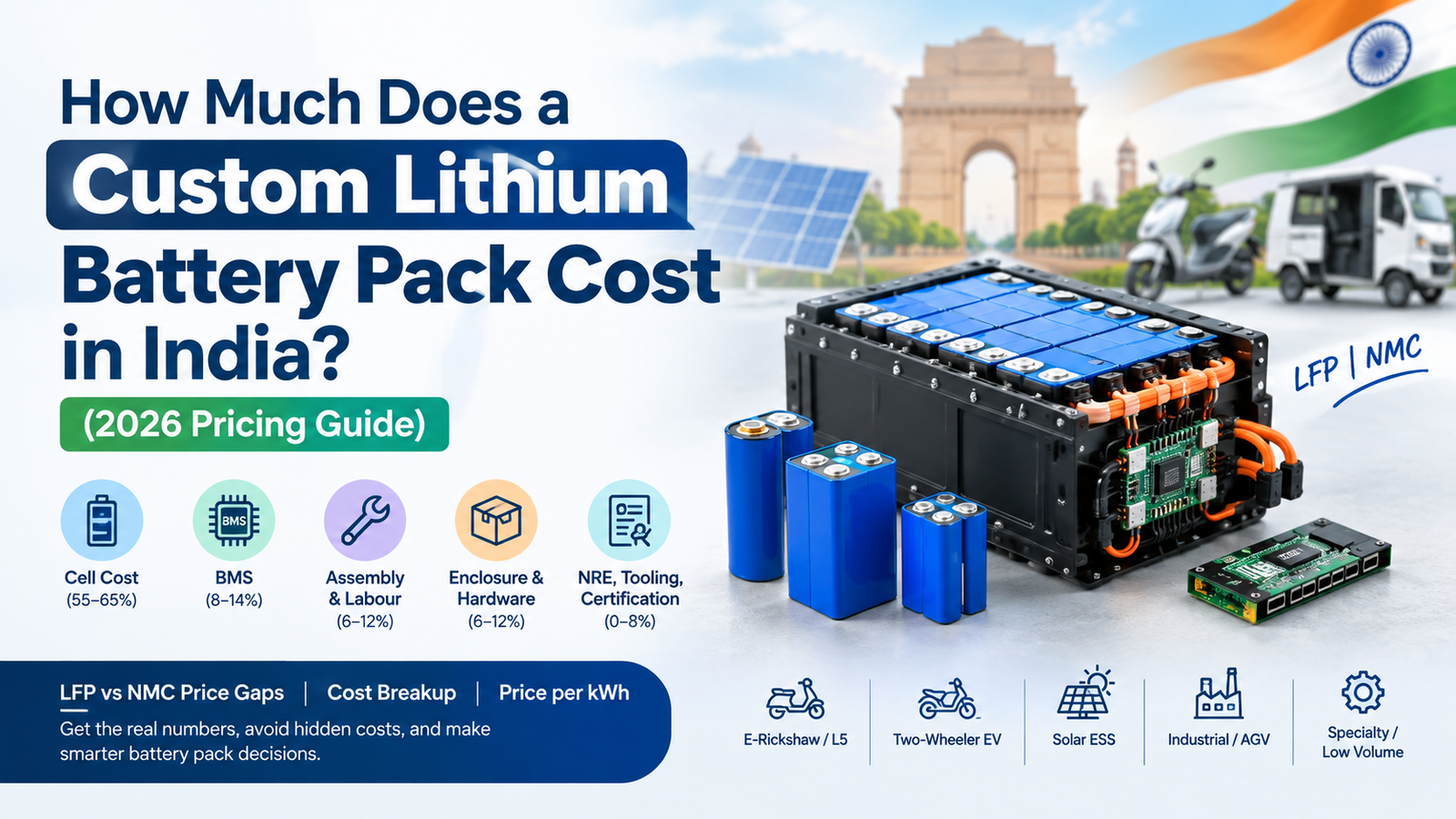
India still imports a large share of cells, but pack-level engineering — cell matching, spot welding, thermal pathways, and BMS integration — is where domestic value sits today. That is exactly the gap a serious lithium battery manufacturer India partner is paid to close.
Expect process discipline around incoming IR/capacity matching, enclosure CAD, communication protocols (CAN / RS485 / Bluetooth), and NABL-linked test evidence. Skipping any of those steps shows up later as warranty claims.
Buyer Checklist Before You Lock a Chemistry
- Confirm chemistry vs duty cycle (LFP for heat and cycles; NMC for energy density).
- Demand cell brand and grade traceability — not just “Grade A†on a quote.
- Review BMS protections: overcharge, over-discharge, over-current, thermal cut-off.
- Ask for AIS-156 / IEC 62133 / UN 38.3 reports as applicable.
- Validate enclosure IP rating and vibration design for Indian roads.
- Compare warranty in real cycles and calendar years, not marketing slogans.
Form Factors Inside Modern Types of Battery Packs
Chemistry is only half the story. The same LFP or NMC cells can ship as cylindrical modules, prismatic bricks, or pouch stacks, and each form factor changes cooling, serviceability, and crash behaviour.
Cylindrical packs are still common in light EV and tool applications because cell matching and replacement are straightforward. Prismatic modules dominate many ESS and e-rickshaw designs where packing efficiency and simpler busbar layouts matter. Pouch cells appear where space is awkward, but they need more careful mechanical support.
When you compare types of battery packs, ask suppliers to explain why they chose a format — not only which logo is printed on the cell wrap.
BMS and Safety Across Pack Types
Every serious pack type needs protection that matches its chemistry. LFP can tolerate some abuse better than high-nickel NMC, but that is not a licence for a cheap BMS. Over-current, cell imbalance, and charger faults still kill packs in the field.
- Cell-level or group-level voltage sensing with realistic balance current
- Temperature sensors placed where heat actually builds
- Clear fault codes for service teams, not cryptic LEDs alone
- Communication that matches the host (CAN for vehicles, dry contact or Modbus for many ESS sites)
Safety standards and transport rules sit beside chemistry choice. Treat AIS, IEC, and UN documentation as part of the pack definition — especially if you sell into regulated EV channels.
Total Cost of Ownership Beats Brochure Wh/kg
Procurement teams often over-index on INR per Wh. Field cost includes downtime, spares, labour, and warranty friction. An LFP pack with honest cycle life can beat a cheaper NMC quote after two Indian summers.
Build a simple model: expected daily DoD, ambient profile, charge window, and replacement labour. Then ask each bidder to populate the same sheet. The winning types of battery packs become obvious once the spreadsheet matches reality.
Common Mistakes When Specifying Pack Types
- Copying a European or US duty cycle into Indian monsoon and heat without derating
- Mixing cell lots without impedance matching
- Buying enclosure IP ratings that look good on paper but fail on cable glands
- Ignoring charger compatibility and communication handshakes
- Accepting “Grade A” labels without brand and batch traceability
Avoid those traps and most chemistry debates get simpler. You are no longer arguing religion — you are matching engineering constraints.
FAQ: Types of Battery Packs
Which types of battery packs are best for Indian EVs?
For most two- and three-wheelers in Indian heat, LFP packs are the safer default. NMC still wins where range and weight dominate and thermal design is done properly.
Are lead-acid packs obsolete?
Not for every UPS or SLI use case. They are obsolete as a growth path for new EV traction packs and most modern solar ESS projects.
When should I consider solid-state packs?
Monitor them for 2030+ product roadmaps. For 2026–2028 launches, specify proven Li-ion chemistries with a supplier who can migrate later.
Do custom packs cost more than off-the-shelf packs?
Unit price can be higher, but total cost of ownership is often lower when the pack matches the real duty cycle, enclosure, and BMS protocol.
What documents should a pack supplier share?
Cell datasheets, BMS specification, sample test reports, and compliance certificates from accredited labs — not only an internal CoC.
Final Words
Understanding the different types of battery packs is the difference between a quote that looks cheap and a pack that survives Indian roads, summers, and warranty years. Match chemistry to duty cycle, insist on engineering evidence, and treat the BMS as part of the product — not an afterthought.
M3S Mobility builds custom lithium packs for EV, solar, and industrial buyers who need India-ready design, not brochure specs. If you are scoping voltage, capacity, and enclosure constraints, talk to the team for a soft technical review and quotation.